!
Warning
Proceed as you would onto any site: at your own risk, with your eyes open.
The Guild Reading Room / Draft 0.3
GM. My name is FLX. For now I'm a lone builder, but I believe we can rebuild better. We can outbuild centralization and control with freedom, culture, craft, honest money, and private tools. I need help. We need to become more. Only a critical mass of builders can turn this from a signal into workshops, homes, gardens, machines, libraries, and living places. The time is now, because we already have what we need: Bitcoin, Nostr, gaming engines, open hardware, cryptography, privacy, and the will to build peacefully around the systems that failed us. No coffee, no workee.
!
Proceed as you would onto any site: at your own risk, with your eyes open.
P
Communities build what their money lets them remember.
"It is inevitable that people will see this kind of new paradigm as the better paradigm than the walled garden we are currently having. They won't figure out the algorithm that makes it right — we will have to do something else. We will have to build back better with Bitcoin." — DerGigi
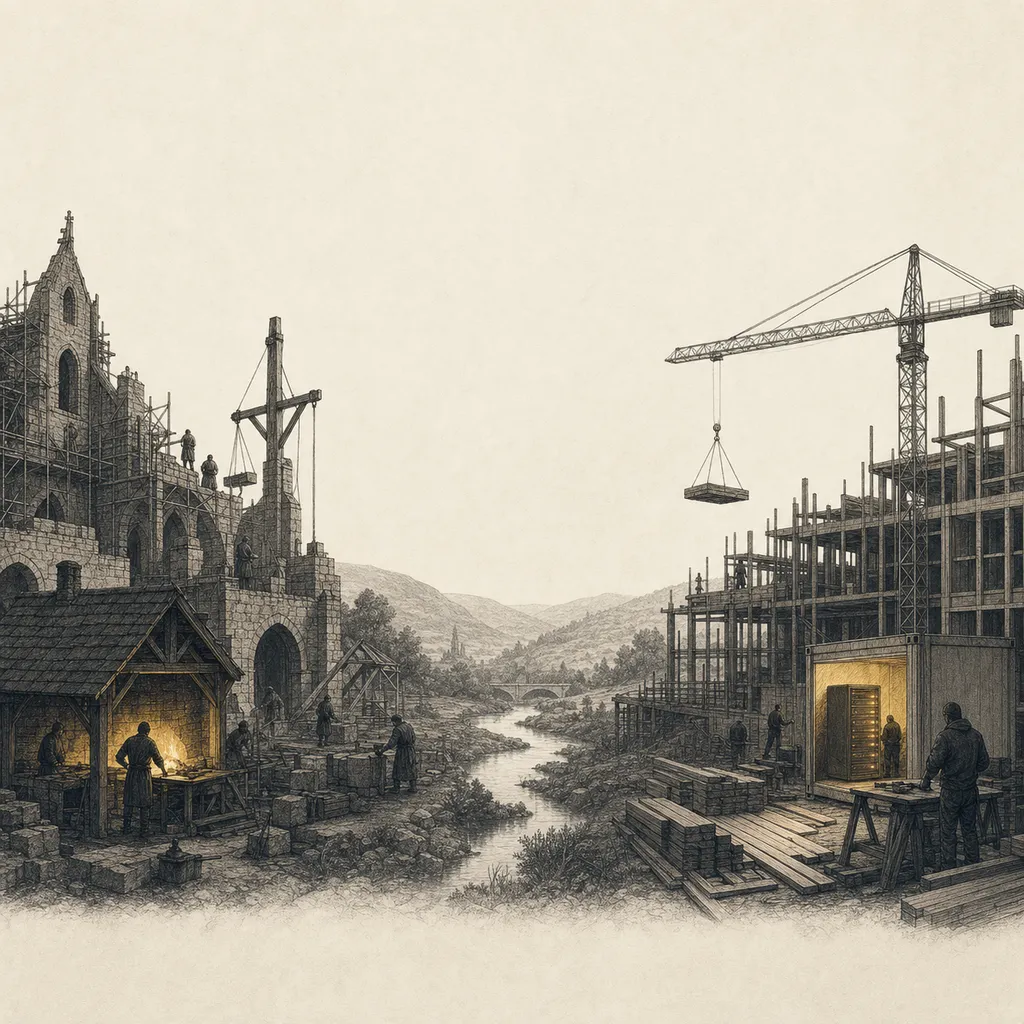
There was a time when the concept of money was grounded in the tangible value of gold, and communities around the world engaged in building projects that were monumental not just in scale but in collaborative spirit. Under sound money, the construction of castles, monasteries, and cathedrals was undertaken across generations. A master mason could begin a nave knowing that the endowment funding it would still buy stone in his grandson's lifetime. These projects were not only architectural feats; they were evidence of low time preference — of societies able to save, to plan, and to trust one another across decades, because the unit they saved in held its weight.
In a small village between rolling hills and dense forests, a community once came together to build a monastery. Blacksmiths forged the ironwork, carpenters shaped the wood, stonemasons carved the stone. They worked with their hands and with their judgment, and the structure that rose from their effort stood as a place of refuge for generations. Nobody audited their collaboration through a dashboard. The building itself was the audit.
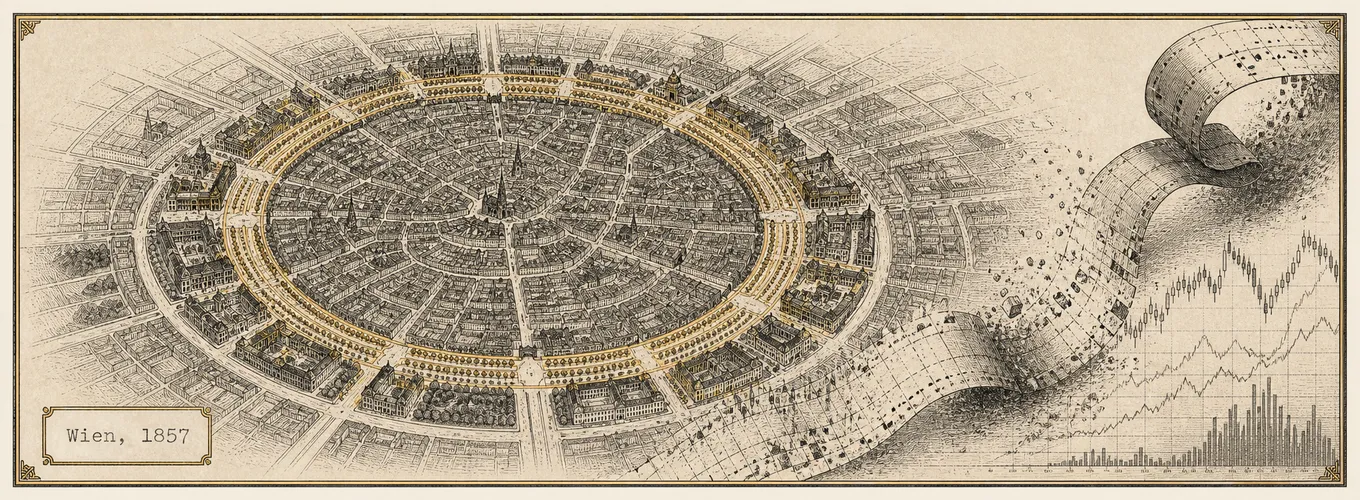
The construction of the Vienna Ringstraße tells a subtler story, and this book's author, who once lived beside it, insists on telling it whole. Following Emperor Franz Joseph's decree of December 1857, the old fortifications were leveled and a boulevard was laid out to join Vienna's suburbs to the imperial centre — not a straight axis carved through the city in the fashion of the age, but a ring: Vienna, of all things, refused the straight line. (A Viennese painter would later put the refusal into words this book's final chapters share: the straight line is godless.) The project financed itself by an alchemy every developer should study: the demolished glacis was sold as building plots, land converted into capital, capital converted into architecture — the Opera, the University, the twin museums, the Parliament — half a century of work, in silver-backed gulden, by crafts that could not be faked.
And then the era supplies its own control experiment. The Gründerzeit boom that financed the Ring's palaces ran on expanding credit, and in May 1873 — the year Vienna opened its World's Fair — the exchange crashed and took the speculators, the paper fortunes, and half the building societies with it. Note precisely what evaporated and what remained. The credit was gone. The buildings stood. They stand today, housing the same institutions, because a boulevard of dressed stone and trained hands is capital, and a leveraged claim on next year's plot price never was. The Ringstraße is not this book's proof that the nineteenth century had sound money throughout — it did not, and paid for it on schedule. It is proof of something more useful: that when the printing stops, the difference between credit and capital is suddenly, brutally legible — and it is measured in what is still standing. Builders produce the part that remains. This book is about giving them money and records with the same property.
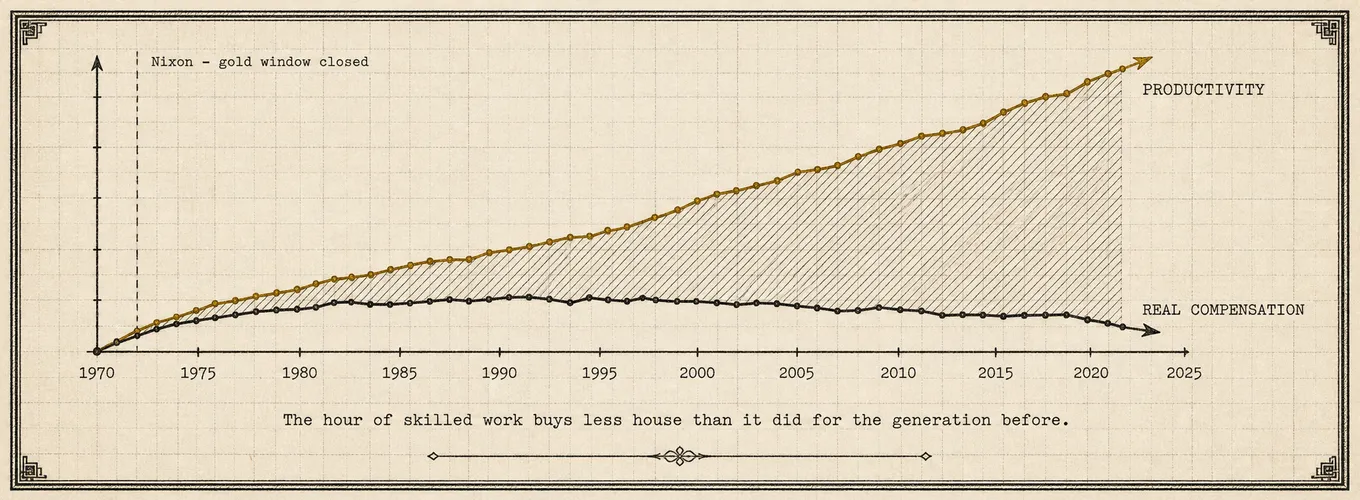
Then the world changed. The Austro-Hungarian Empire did not survive the strain of the First World War; the treaties of Saint-Germain and Trianon formalized its dissolution. Out of the wreckage of the old order, a new monetary one emerged. The United States, industrially intact, rose to financial dominance; Bretton Woods pegged the world's currencies to the dollar and the dollar to gold. And in August 1971, President Nixon suspended that final convertibility. Money's anchor was cut. From that point on, the value of the unit in which builders price, borrow, save, and get paid has rested on policy rather than on weight or measure.
Something else changed around the same time, and every wage earner has felt it since: for the postwar decades, productivity and compensation in the industrialized world grew roughly together; from the early 1970s onward they diverged. Output per hour kept climbing while real pay lagged further and further behind. Economists argue about the mechanisms. Builders experience the result. An hour of skilled work buys less house than it did for the generation before — in the very industry that produces houses. The people who build the world are increasingly unable to afford the world they build. Whatever else one concludes from that, it is not a sign of a healthy measuring stick.
This book is about three technologies that respond to that condition, and about the industry where they may matter most.
Bitcoin restores a money whose supply no committee can adjust — a scarce, neutral, borderless settlement network in which value can be saved and transferred without permission. Nostr restores communication and coordination without platforms — identities and records held by their owners, transported by interchangeable relays, impossible to deplatform because there is no platform. Gaming engines turn static plans into shared, walkable, testable worlds — collapsing the distance between the people who design buildings, the people who build them, and the people who will live in them.
None of these was invented for the construction industry. That is precisely why they matter to it. Construction is the largest, most fragmented, most under-digitized industry on earth — a coordination problem measured in trillions, operating on adversarial contracts, delayed payments, and data that dies at every handover. An industry like that does not need another portal. It needs better primitives: harder money, freer information, shared reality.
"We have proposed a system for electronic transactions without relying on trust." — Satoshi Nakamoto
A note on this edition. The first draft of this book was written in early 2024. Since then, the world has run the experiment further: a superpower established a strategic bitcoin reserve, the European Union brought the first comprehensive digital-asset regime into force, developers of privacy software were sentenced to prison while the sanctions against their code were struck down, the Nostr ecosystem quietly built payment and coordination rails nobody had asked permission for, and Max Hillebrand published The Praxeology of Privacy, giving the cypherpunk toolbox its Austrian-economic foundation. This second edition has been rewritten around what is now verifiable rather than what was then imaginable. Numbers are cited with dates and sources; where a claim is a vendor's survey or an estimate, it is labeled as such; where something failed, the failure is reported. Serious optimism has nothing to fear from honest accounting.
And a note on the stories. Each chapter of this book opens with a page from the life of a figure we call only the Builder — a building-services engineer in a city where the dashboards are green and the numbers don't match. The Builder's world is fiction — this book's own. The gap it measures is not. The city, the workshop, and the mark scratched into the conduit run beneath the argument the way services run beneath a street: unseen, load-bearing, and connected at every riser. You need to know only this: the Builder is the kind of person who writes the real number down. No name, no gender, no rank — just the notebook, and the habit.
One debt in this book must be acknowledged by name. Years before any of these chapters existed, its author fell down a rabbit hole that a pseudonymous engineer who signs himself Gigi had marked with a small book: 21 Lessons — What I've Learned from Falling Down the Bitcoin Rabbit Hole. That book asked for no money and no permission — published free, licensed open, paid in gratitude and sats: value-for-value practiced years before this book learned the term. It opens with Alice, and it ends the way all honest rabbit holes do — with the reader building. Danke, Gigi: this book followed your white rabbit, and the epigraph above is only the most visible of its debts. "'Begin at the beginning,' the King said gravely, 'and go on till you come to the end: then stop.'"
We are culture. Buildings are how a civilization remembers itself. What we build — and what we build with — is never neutral.
FLX — Tirol, July 2026
00
Trust the instrument, not the dashboard.
Every builder knows the moment. The model says the duct fits; the site says it doesn't. The schedule says week 34; the trades say November. The dashboard says the project is 71 percent complete; the concrete says otherwise. Construction people develop, early and permanently, a professional relationship with the difference between what is reported and what is real — because in this industry, unlike in most others, reality eventually shows up in person, weighs several thousand tonnes, and doesn't read the report.
This book takes that professional instinct — trust the instrument, not the dashboard — and applies it to the systems the construction industry runs on: its money, its communication, and its models.
The argument, in brief:
Money. The unit in which the industry prices, borrows, and pays has no fixed definition. Since 1971 it has been a policy instrument, and the people furthest from the printer — wage earners, subcontractors, savers — pay for that in ways that never appear on any invoice. Bitcoin is the first working alternative: a money with a fixed supply of 21 million units, secured by physical work, owned by whoever holds the keys, transferable across any border in minutes. It is not a get-rich scheme; in the year before this edition, its price fell by half from its all-time high, and this book will quote those numbers plainly. It is a different kind of money — one that behaves like an instrument instead of a dashboard.
Communication. The industry coordinates through platforms it does not control: proprietary common-data environments, hosted project rooms, chat tools, portals — each a walled garden with a subscription, an API that can change, and a shutdown date nobody knows in advance. Nostr is the counter-model: a protocol so simple it fits in a few pages, in which identities are cryptographic keys held by their owners, records are signed events, and servers — relays — are interchangeable commodities. Nobody can deplatform a keypair. Nothing signed can be silently altered. For an industry whose core legal artifact is the question "who sent what to whom, when?", this is not a social-media curiosity. It is infrastructure.
Models. The industry has spent two decades building information models, then flattening them into PDFs because the tools for sharing living models were locked inside expensive, incompatible silos. Gaming engines — the technology that renders persistent, physically simulated worlds for hundreds of millions of players — have crossed into architecture, engineering, and construction. A model you can walk through together is a different social object than a drawing you can only review. It changes who gets to participate in design, and how early errors are found.
Three further chapters give these tools their context. One is about privacy — guided by Max Hillebrand's The Praxeology of Privacy (2026), which grounds the cypherpunk toolset in Austrian economics and answers, rigorously, why selective disclosure is a precondition of functioning markets rather than a suspect's privilege. In an industry that lives on sealed bids, confidential negotiation, and trade secrets, that argument deserves a builder's full attention. Another chapter is about geopolitics — the strategic reserves, regulations, prosecutions, and energy flows that now shape what builders may legally and practically do with these tools, from the EU's MiCA and AMLR to the U.S. Strategic Bitcoin Reserve to mining rigs doubling as boilers. The final chapters assemble the pieces into a reference architecture for a decentralized construction ecosystem, take an honest inventory of the barriers, and look forward.
A word on method. This book was written by an engineer, and it follows engineering rules. Units are SI. Claims carry dates and sources, collected chapter by chapter at the back of the book. Vendor surveys are labeled as vendor surveys; estimates as estimates; ideas that have never been tested as exactly that. Where the record includes failures — a major engine vendor abandoning its construction product, a privacy company shutting down its own service under legal pressure, a protocol whose daily active users would fit in a mid-sized football stadium — the failures are printed. The economics follows the Austrian tradition: methodological individualism, subjective value, time preference, and a deep suspicion of aggregates that no one can stand next to and measure. Praxeology, the logic of human action, asks not "what does the dashboard say?" but "what must be true because people act?" It is, in that sense, the economics of people who take their own readings.
One more thing. This is not a neutral book, and it does not pretend to be. It was written in the conviction that the builders — the people who pour, weld, wire, balance, and commission the physical world — deserve tools that respect them: money that keeps what it promised, records that cannot be quietly revised, models that everyone on the project can enter. But conviction is cheap; the book's standard is that every load-bearing claim should survive the reader checking it. Where you disagree, take your own reading. That is, after all, the entire point.
We are culture. We don't confront the system — we outbuild it. Let's look at the numbers.
C0
Bitcoin, Nostr, and gaming engines, stated plainly.
Before this book can argue anything, it owes you a plain account of its three subjects: where they came from, how they work, and — because this edition insists on it — what state they are actually in as of mid-2026, in numbers, with the disappointments included.
In the autumn of 2008, in the middle of the global financial crisis, a pseudonymous author calling themself Satoshi Nakamoto posted a nine-page paper to a cryptography mailing list: Bitcoin: A Peer-to-Peer Electronic Cash System. The paper proposed something the cypherpunk community had circled for two decades without landing: digital cash that needed no issuer, no bank, and no trusted third party of any kind.
The components were not new. Adam Back's Hashcash (1997) had shown that computational work could be used as a stamp — costly to produce, trivial to verify. David Chaum had built digital cash in the 1980s, but with a central mint that could be shut down (and was). Wei Dai's b-money and Nick Szabo's bit gold sketched decentralized designs without solving the problem of agreement: who decides which ledger is the real one, if nobody is in charge?
Satoshi's synthesis solved it. Transactions are broadcast to an open network. Miners gather them into blocks and race to solve a proof-of-work puzzle; the winner appends the next block to a growing chain of blocks and collects newly issued bitcoin plus fees. Each block commits cryptographically to its predecessor, so rewriting history would require redoing the work — and outpacing the honest network while doing so. Every participant running a full node independently verifies every rule: no invalid signature, no double-spend, and never more than the fixed issuance schedule allows. Consensus emerges not from authority but from the most cumulative verifiable work. In early drafts and code comments, Satoshi had a name for this timestamped structure that has since been widely adopted by those who care about the original terminology: the timechain. This book uses that word — because what the structure actually provides is not "a chain of blocks" (a database detail) but ordered, unforgeable time: proof that a record existed, in sequence, beyond anyone's power to backdate or revise.
On 3 January 2009, Satoshi mined the first block. Embedded in it was a newspaper headline of that day — "Chancellor on brink of second bailout for banks" — part timestamp, part epitaph for the system Bitcoin was answering. Hal Finney, veteran cypherpunk and creator of the first reusable proof-of-work system, received the first transaction and famously tweeted "Running bitcoin." From those two computers, the network grew: cypherpunks first, then libertarians, tinkerers, economists, criminals (money is money), entrepreneurs, funds, and eventually governments.
The monetary design is the point, and it is austere. Supply is capped at 21 million bitcoin, each divisible into 100 million satoshis. New issuance halves roughly every four years: since the fourth halving on 20 April 2024, each block mints 3.125 BTC, roughly 450 BTC per day network-wide — an annual supply growth already below one percent and falling toward zero. No board meets to reconsider this. Changing it would require convincing tens of thousands of node operators to run software against their own interest — a governance model best described as everyone can propose, nobody can impose.
Where does that leave Bitcoin in mid-2026? Larger, more institutional, and — honesty first — bruised. The network's computing power stands near one zettahash per second, the highest sustained security budget of any system humanity operates, though the first quarter of 2026 saw the first quarterly hashrate decline in six years as some miners pivoted capacity to AI workloads. U.S. spot exchange-traded funds, approved in January 2024, accumulated over 50 billion dollars in net inflows before reversing into record outflows in 2026. The price reached an all-time high of 126,198 dollars on 6 October 2025, crashed within days when a 100-percent-tariff announcement triggered roughly 19 billion dollars of leveraged liquidations — the largest single-day deleveraging on record — and traded near 60,000 dollars in the summer of 2026. In March 2025 the United States established a Strategic Bitcoin Reserve holding six figures of seized coins. Volatility has not gone away, and this book will not pretend otherwise. What has gone away is the question of survival: seventeen years of uptime, every obituary unretracted.
"If you have an apple and I have an apple and we exchange these apples then you and I will still each have one apple. But if you have an idea and I have an idea and we exchange these ideas, then each of us will have two ideas." — attributed to George Bernard Shaw
The second technology answers a different failure. The internet's original promise — anyone can publish, anyone can read — was quietly repossessed by platforms. A handful of companies came to own the world's conversations: the identities, the social graphs, the archives, the reach. What a platform giveth, a platform can taketh away — accounts, audiences, entire histories — by policy, by algorithm, or by acquisition.
Nostr — Notes and Other Stuff Transmitted by Relays — is a protocol, not a platform, released in 2020 by a pseudonymous Brazilian developer known as fiatjaf. It grew in the same free-software soil as tools like LNbits, the open-source Lightning account system built by Ben Arc — one of the ecosystem's most relentless FOSS builders, and proof that a single stubborn developer giving code away can end up carrying half an industry's plumbing. Nostr inherited exactly that culture: everything open, everything forkable, nobody's permission required. Its design is almost insultingly simple, and the simplicity is the strategy. An identity is a cryptographic keypair. A message — a "note," or any other stuff — is a small JSON document called an event, signed by its author's key. Events are published to relays: dumb servers that store and forward whatever they accept. Clients — apps — read from and write to many relays at once.
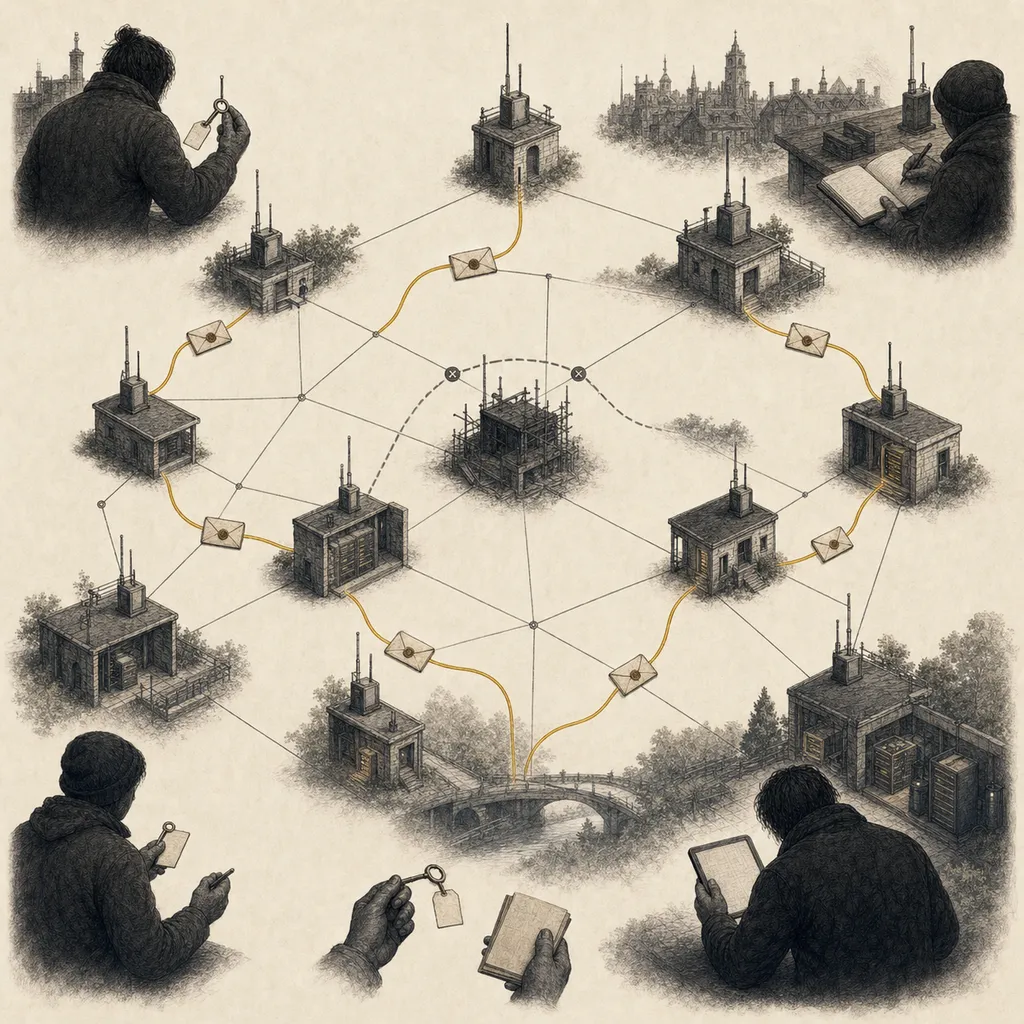
That is the whole protocol. Everything else is optional extensions, called NIPs (Nostr Implementation Possibilities), which clients and relays adopt à la carte. From these few moving parts, properties fall out that platforms cannot offer. Your identity is yours: no company issues your key, so no company can revoke it. Your words are portable: if one relay deletes or blocks them, publish to another; followers find you by key, not by server. Your record is verifiable: a signed event either verifies or it doesn't; nobody can put words in your key's mouth or quietly edit what you said. And the system has no headquarters: over 950 relays across roughly 50 countries were online in early 2026 (as read from public relay monitors), operated by companies, volunteers, and hobbyists, none of them essential.
Chapter 4 examines the ecosystem in detail — the payments layer, the encrypted messaging, the file hosting, the git collaboration, the machine-to-machine experiments — and gives the honest usage numbers, which are modest. Here it suffices to register what kind of thing Nostr is: not a Twitter competitor, but a coordination substrate — a way for keys (people, companies, or machines) to publish signed, timestamped statements that anyone can verify and that no single party can unilaterally suppress. Hold that thought until we reach the question of what a construction project actually is, legally speaking. The answer — a pile of signed, timestamped statements that everyone argues about later — is coming in Chapter 1.
"The Matrix is everywhere. It is all around us. Even now, in this very room. You can see it when you look out your window, or when you turn on your television. You can feel it when you go to work." — Morpheus, The Matrix
The third technology was built for play, which is why it works. A game engine is a real-time simulation kernel: geometry, materials, light, physics, sound, input, networking — everything needed to render a persistent, interactive world at 60 frames per second and share it among many participants. The two dominant general-purpose engines, Epic Games' Unreal Engine and Unity, were hardened by the most demanding users imaginable: hundreds of millions of players who riot when the frame rate drops.
Architecture noticed early. The pipeline from building information model to engine — once a heroic act of file surgery — became a product: Epic's Datasmith importers translate Revit, Archicad, Rhino, and IFC geometry with materials and metadata intact, and Twinmotion, Epic's architectural visualization tool, ships bundled with Revit itself. Unreal Engine 5's rendering advances (virtualized geometry, real-time global illumination) mean a full-detail building model can be explored photorealistically without manual optimization. On the open side, projects like Speckle stream AEC model data to web browsers over open APIs, and NVIDIA's Omniverse bet on OpenUSD as a universal scene format for industrial digital twins — factories, data centers, districts.
The honest ledger requires the failure too: Unity, the second giant, launched its dedicated AEC product Unity Reflect in 2019 to considerable fanfare — and sunset it in 2023–2024, pointing customers to third-party tools. The lesson, to which this book returns repeatedly, is not that engines don't belong in construction. It is that products die and protocols survive, and an industry with fifty-year asset lifecycles should be careful about which one it marries.
Why do engines matter beyond pretty pictures? Because a walkable model changes who can participate. A drawing set is a document for the initiated; a first-person walkthrough is legible to the apprentice, the client's board, the facility manager, and the future tenant. Design review in a shared virtual space catches what paper hides: the valve you can't reach, the corridor that feels wrong, the maintenance access that exists only in the clash report's dreams. Training moves from classroom to simulation. And a generation raised in Minecraft and Fortnite — a generation the construction industry desperately needs to recruit — walks into these tools already fluent.
"The curious task of economics is to demonstrate to men how little they really know about what they imagine they can design." — Friedrich Hayek
Hayek's warning is the thread that ties the three technologies together. Each of them replaces a designed authority with a discovered order: Bitcoin replaces the monetary committee with a fixed rule and open competition; Nostr replaces the platform with a swarm of interchangeable relays; the engine replaces the privileged drawing with a world anyone can inspect. None of them requires the people using them to be wise, honest, or aligned — only to act, visibly, under rules that no participant can bend. That is not a technological preference. It is an epistemological one, and the next chapter shows why the construction industry — fragmented, adversarial, and drowning in unverifiable reports — needs it more than any industry on earth.
C1
The physical industry has learned to distrust perfect dashboards.
Construction is the largest industry humanity operates, and by most honest measures the least improved. This chapter takes its readings: productivity, fragmentation, error, data, and money. The numbers are the load calculation for everything the rest of the book proposes — nothing that follows makes sense unless the scale of the dysfunction is first measured, dated, and sourced.
The canonical measurement comes from the McKinsey Global Institute's 2017 study Reinventing Construction, and its vintage matters — the figures are pre-pandemic, but no comparable re-estimate has replaced them, and McKinsey's 2024 follow-up confirms the diagnosis stands. Global construction-related spending is on the order of 10 trillion dollars a year, around 13 percent of world GDP. Over the two decades before the study, construction labor productivity grew about 1 percent per year, against 2.8 percent for the world economy and 3.6 percent for manufacturing. If construction merely caught up with the whole-economy average, the study estimated the sector's value added would rise by 1.6 trillion dollars per year — the size of a G7 economy's construction market, currently paid annually as a tax to the confusion.
For the United States, the independent record is harsher. A 2025 Federal Reserve Bank of Richmond brief, drawing on the Bureau of Labor Statistics' official construction productivity series, finds that measured U.S. construction labor productivity declined by more than 30 percent between 1970 and 2020, a five-decade slide over the same period in which economy-wide productivity roughly doubled. Measurement caveats exist — quality, regulation, and project mix are hard to deflate — but no plausible correction turns a 30-percent decline into progress. Every other major industry learned to make more with an hour of human work. Construction learned to make less.
Why? The literature converges on structure rather than laziness. Construction is hyper-fragmented: the European Union counts over 3 million construction enterprises employing over 12 million people, of which roughly 95 percent are micro or small firms — the average European construction firm has about three to four employees. Every project assembles a temporary coalition of dozens of such firms under adversarial contracts, builds a one-off prototype in the rain, and disbands before the lessons can compound. Manufacturing improves because the factory persists. Construction re-founds the factory every Monday.
Fragmentation has a direct cost line: rework. The Construction Industry Institute's research puts direct field rework at around 5 percent of construction cost on average, with a range from 2 to well past 10 percent depending on project type and — critically — on how honestly it is measured; most published studies cluster between 4 and 12 percent. The UK's Get It Right Initiative, which set out to count indirect and latent error as well, estimates the total cost of avoidable error at 10 to 25 percent of project cost, with a central estimate around 21 percent once unrecorded process waste and latent defects are included. On a 10-trillion-dollar industry, even the conservative end of these ranges is a sum comparable to entire national economies, spent annually on building things twice.
And error is not merely expensive. The Builder's demolished duct — revision C versus revision D — is the canonical failure mode: not incompetence, but information asymmetry between parties who share a physical reality and do not share a data reality.
The severity of that data problem has an official price tag, and its age is itself the indictment. In 2004, the U.S. National Institute of Standards and Technology (NIST) published study GCR 04-867 on the cost of inadequate interoperability in the U.S. capital facilities industry: 15.8 billion dollars per year (in 2002 dollars), of which about two-thirds fell not on designers or contractors but on owners and operators, mostly during operations and maintenance — the phase that inherits whatever data survives the handover, which is to say, not much. No equally rigorous study has replicated the estimate since; the industry's information stack has been re-platformed twice in the interim, and the honest statement is that we are still spending an unmeasured multiple of that figure. (A 2021 Autodesk-commissioned FMI report put the global cost of "bad data" at 1.85 trillion dollars for 2020 and claimed 96 percent of captured project data goes unused — directionally useful numbers that should be read for what they are: a vendor's survey.)
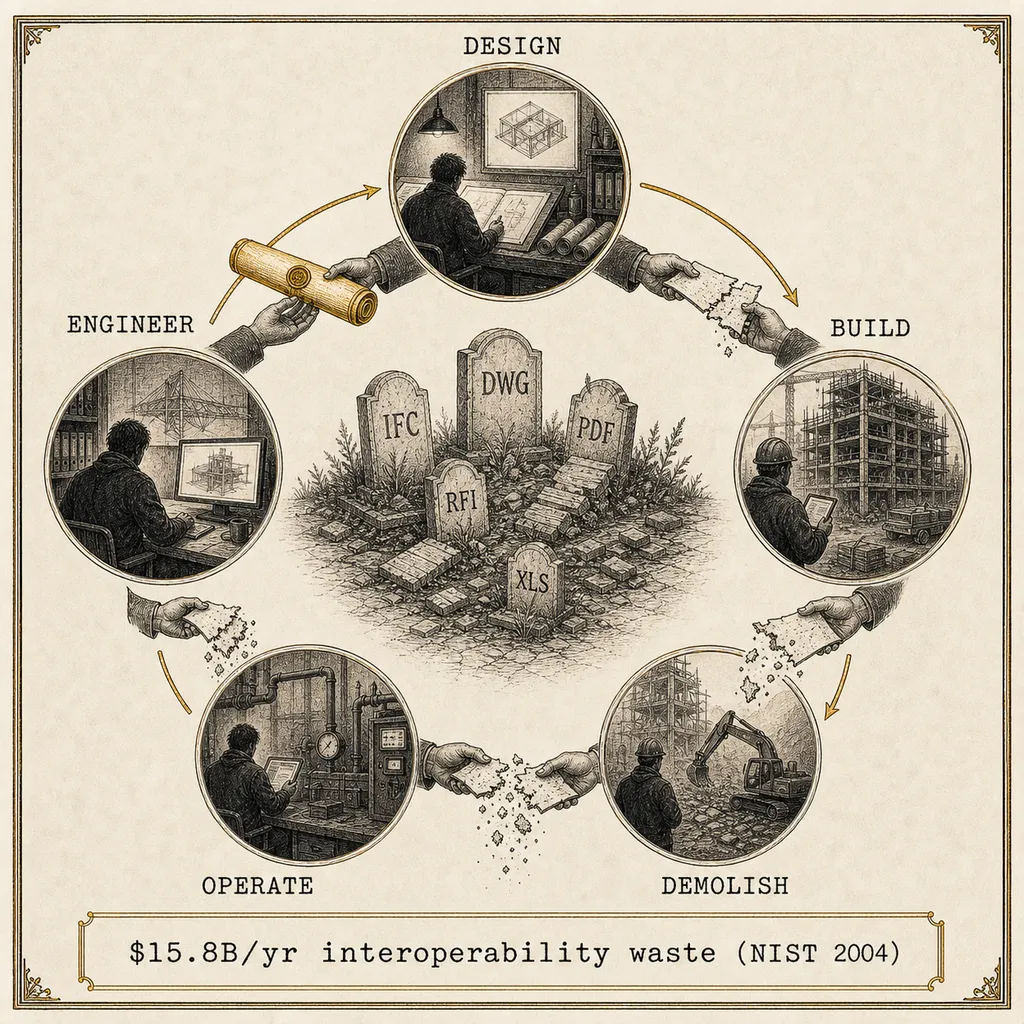
The pattern beneath both numbers is the same. Project information is produced in silos (architect's model, engineer's model, fabricator's model, contractor's schedule, owner's spreadsheet), exchanged as lossy exports, flattened into PDFs for legal comfort, and largely discarded at each phase boundary. The building lives for fifty years; its data rarely survives five.
The industry's answer for two decades has been Building Information Modeling — and credit where due, adoption has genuinely happened. The UK's 2016 mandate matured into the ISO 19650 series, an international standard for managing information across the asset lifecycle, with a common data environment (CDE) as the required single source of project truth; the UK's post-Grenfell Building Safety Act added a statutory "golden thread" of building information for higher-risk buildings. Germany has required BIM on federal infrastructure projects since the end of 2020. Italy mandates BIM on public works above 2 million euros as of January 2025. Spain runs a phased public-procurement BIM plan through 2030. The UK's NBS survey (2025) reports 71 percent of practices using BIM. On the standards side, IFC 4.3 became ISO 16739-1:2024, extending the open data schema beyond buildings to roads, railways, bridges, and ports — the grammar for open exchange exists.
So the models exist. The promise — a shared, trustworthy, living dataset from design through demolition — largely does not. Four gaps explain the difference, and they will organize much of this book:
The interoperability gap. Round-tripping a model between authoring tools remains lossy; native formats rule daily work; the open format is used for milestone drops, not collaboration. In practice, the drawing — flattened, signed, static — remains the contractual document, because it is the only artifact everyone can verify.
The trust gap. A CDE is a database owned by one party under commercial terms. Its audit trail is a feature of software controlled by whoever administers it. When a dispute reaches arbitration, parties reconstruct history from emails precisely because a platform log, editable by its operator, convinces no one. The industry's core evidentiary need — who issued what, to whom, when, unalterably — is not met by any subscription product, as a matter of architecture rather than of vendor goodwill.
The incentive gap. The parties who bear the cost of better information (designers, subcontractors) are not the parties who capture its value (owners, operators, insurers). Fragmented procurement means nobody owns the whole-life data business case; each firm rationally under-invests, and the commons stays poor.
The money gap. Information and cash travel on unrelated rails. A certified progress payment references model states and site records only through human paperwork, which is why it takes so long — and how long it takes is the industry's quietest scandal, measured next.
Construction's payment terms would be considered a crisis in any other industry; here they are custom. The most-cited recent figures come from Rabbet's annual U.S. surveys — a payments-software vendor, so label applied — and they are stark: slow payments cost the U.S. construction industry an estimated 280 billion dollars in 2024 and 299 billion in 2025, a hidden tax the 2025 report puts at 14 percent of construction costs; 82 percent of subcontractors reported waiting more than 30 days past due, up from 49 percent two years earlier. Independent surveys agree on the shape: typical end-to-end payment cycles average 57 days from work performed to cash received, with late-payment cases stretching toward 90, and subcontractors routinely front material and labor costs in the interim — effectively acting as unsecured, uncompensated lenders to the projects they build. Contractors respond rationally by pricing the wait into bids (survey estimates put the markup near 8 percent), so the owner pays for the dysfunction whether or not anyone names it.
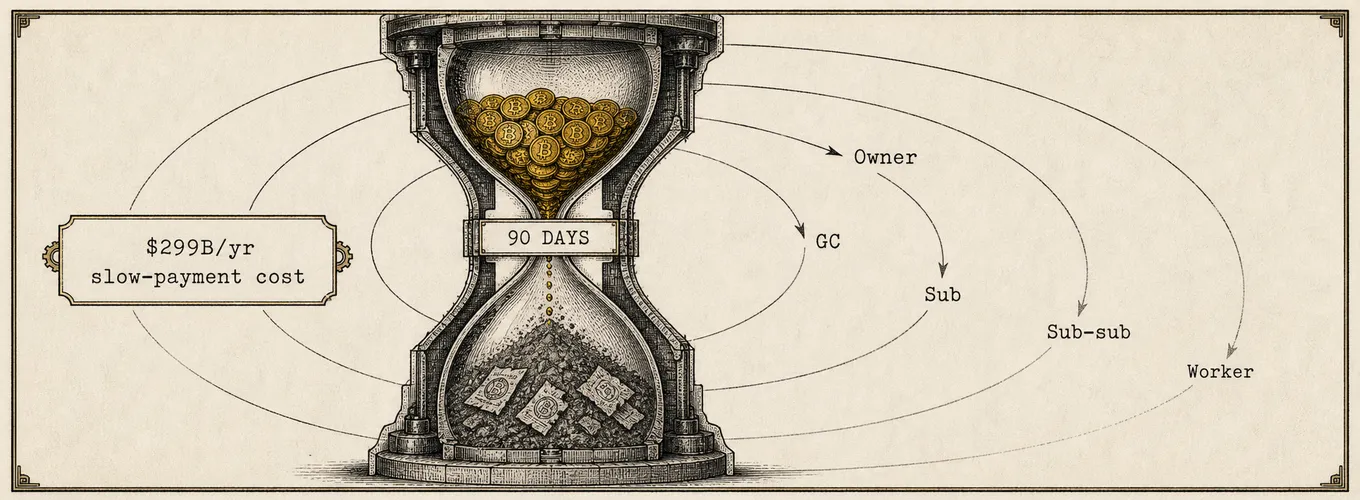
On top of the wait sits retention: 5 to 10 percent of every invoice held back, cascading down the subcontract chain, released months or years later, and — for a small firm — often the difference between solvency and not. Regulators have begun to notice: California capped private-project retention at 5 percent from January 2026; the EU has a proposed regulation to tighten B2B payment terms to 30 days working through its legislature; the UK launched a Fair Payment Code in December 2024. Notice the shape of these remedies: laws begging companies to send money faster, on rails where money simply does not move fast, across a chain of intermediaries who each earn float by holding it. And for the industry's large migrant workforce, one more toll waits at the end: sending wages home costs a global average of 6.36 percent per remittance (World Bank, Q3 2025) against a UN target of 3 — the most regressive fee schedule in finance, levied on the people who pour the concrete.
Add up the chapter's gauges. Productivity: flat for decades where every peer industry compounded. Structure: millions of three-person firms in temporary, adversarial coalitions. Error: 5 percent direct, up to a fifth of project cost all-in, annually. Data: born in silos, dead at handover, cost last rigorously measured in 2004 and never smaller since. Money: 57-to-90-day cycles, double-digit hidden taxes, retention as a business model, and the workforce paying 6 percent to move its own wages.
None of these is a technology problem in the narrow sense — the industry has software in abundance. They are coordination problems among parties who do not trust each other, transacting in money that moves slower than the work, over records that no one can independently verify. That triple diagnosis is the book's hinge. Because coordination without trusted intermediaries, money that settles in minutes, and records that verify themselves are not utopian requests — they are, precisely and respectively, what Nostr, Bitcoin, and open model protocols were built to provide. The following chapters take each in turn — beginning with the money, because the money is the load path everything else hangs from.
C2
A fixed instrument for people who build across long time horizons.
The construction industry's problems, Chapter 1 argued, reduce to coordination, verification, and money. This chapter is about the money — not as an investment thesis, but as an engineering question: what properties does the unit of account and settlement need, for an industry whose projects outlive political administrations and whose supply chains cross a dozen borders? We proceed the Austrian way: first the theory of what money is, then what fiat money does to builders specifically, then what Bitcoin actually offers — with its costs and volatility stated plainly, because a load table with the failure modes deleted is not engineering, it is marketing.
Money is not wealth; it is the medium through which wealth is exchanged and — critically for builders — measured across time. Carl Menger showed that money emerges from barter as the most saleable good: people converge on whatever commodity loses least value in trade, and its universal acceptance becomes self-reinforcing. Historically the winners were goods that were durable, divisible, portable, verifiable, and above all scarce — hard to produce at will. Gold won for centuries because its supply grew at low single digits per year no matter how badly kings wanted otherwise.
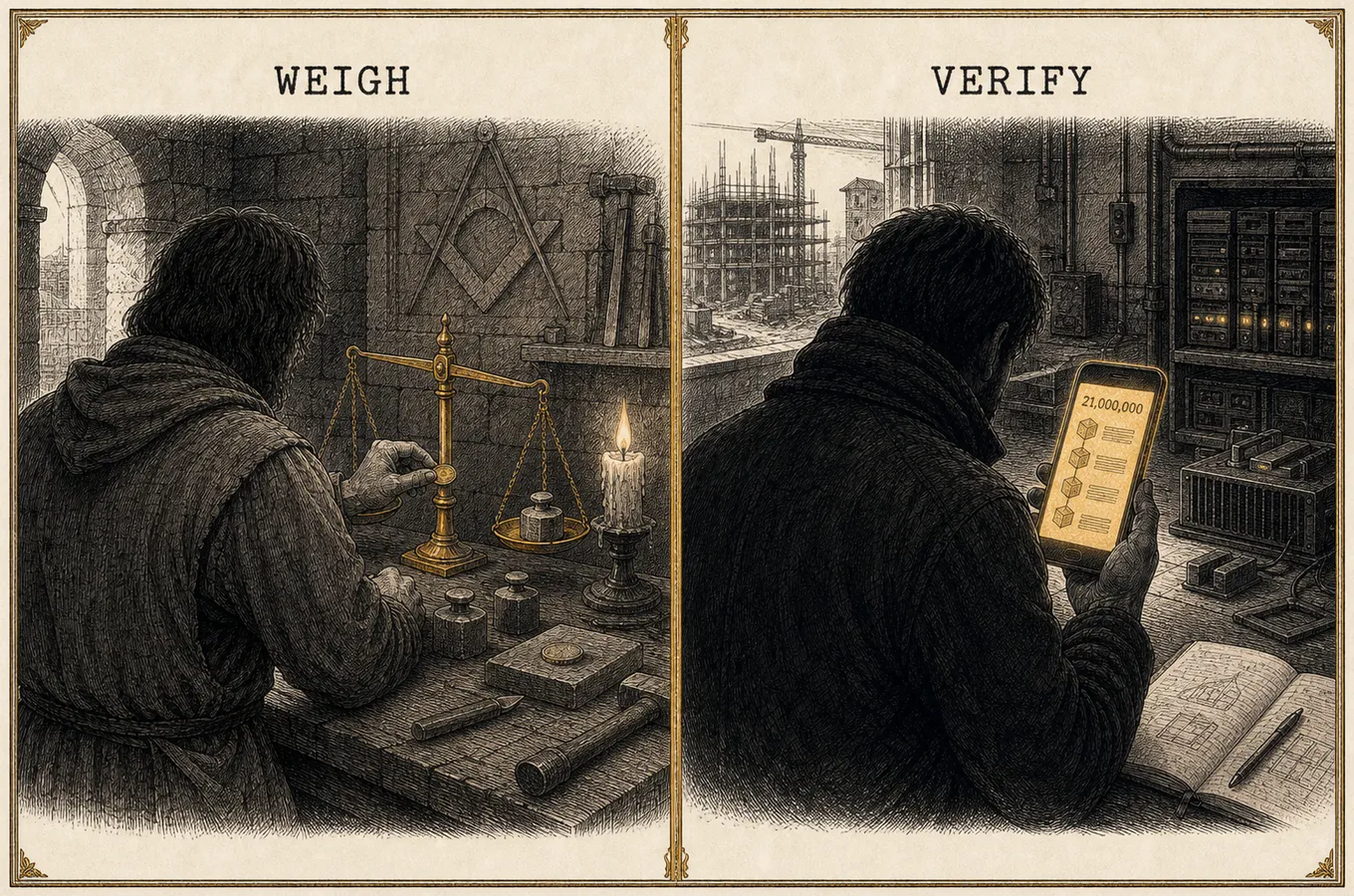
Ludwig von Mises extended the point with a theorem builders will find intuitive: economic calculation — knowing whether a project creates or destroys value — is only possible with genuine prices, and genuine prices are only possible when money itself is not being silently re-scaled. Every estimate, every tender comparison, every life-cycle cost analysis is an exercise in calculation. Do it with a rubber ruler and the errors compound quietly until they arrive, as they always do in construction, in person.
And there is a deeper variable underneath: time preference — how heavily people discount the future against the present. Low time preference is the precondition of civilization in general and construction in particular: nobody quarries foundations for a cathedral, plants an oak avenue, or trains an apprentice for four years unless the future is worth saving for. Hans-Hermann Hoppe's observation is central to this book: the quality of money and the time preference of society move together. Money that holds value rewards waiting, saving, building for decades. Money that leaks value teaches everyone — workers, firms, governments — to grab, spend, and leverage now. An industry whose entire product is the long term has more exposure to this variable than any other.
Since 1971 the world has run on money whose supply is a policy output. The consequences are usually discussed in macro abstractions; here is the builder's itemized bill.
The measuring stick shrinks. Construction cost indices compound faster than official consumer inflation in most decades, and every multi-year project prices this in as risk: escalation clauses, contingency, hedging — pure overhead paid to the instability of the unit itself.
Savings can't cross a project cycle. A subcontractor's working capital, a family's down payment, a maintenance reserve fund — all decay at the rate of monetary expansion minus whatever yield the saver can chase. Hoppe's arithmetic again: when holding is losing, everyone is pushed out along the risk curve or into debt. The firm that would once have saved toward its own equipment now leases everything, permanently, from balance sheets closer to the money spigot.
The Cantillon geometry. New money enters somewhere — banks, asset markets, state contracts — and prices adjust from there outward. Those nearest the entry point buy at yesterday's prices with today's money; wage earners at the end of the chain buy at tomorrow's prices with yesterday's wages. Construction sits astride this geometry painfully: its asset side (land, buildings) inflates as money seeks shelter, while its labor side falls ever further behind the assets it produces. The tradesperson who cannot afford the apartment they wire is not a paradox. They are the mechanism, working as built.
Boom, bust, repeat. Austrian business-cycle theory describes how artificially cheap credit lengthens production structures beyond what real savings support — and construction, the longest production structure in the economy, is always the first hired and first fired. Every credit cycle of the past century has used building sites as its amplitude gauge: 2008 was a construction crisis before it was a banking one.
None of this is fixed by better software. A perfectly coordinated, fully modeled, flawlessly scheduled project still bleeds if the money it is priced, financed, and paid in is itself the unstable component.
Bitcoin's monetary properties, restated from Chapter 0 as specifications: supply asymptotic to 21 million, issuance halving every 210,000 blocks (3.125 BTC per block since April 2024, annual growth already under one percent), rules enforced not by an administrator but by every full node independently, history ordered in a timechain whose rewriting would require redoing more physical work than the rest of the network can muster. Custody is a keypair: whoever holds the keys holds the asset, with no counterparty, no bail-in risk, no re-denomination. Settlement is final in about an hour, globally, without permission.
For the saver — the apprentice, the subcontractor, the maintenance fund — this is the first instrument in two generations whose supply cannot be adjusted against them. Volatile, yes; the honest numbers follow shortly. But volatility is a market price discovering itself in the open, which is a different animal from the quiet, permanent, one-directional dilution it replaces. As Max Hillebrand puts it: surveillance distorts prices the way money-printing does — and sound money is the instrument-grade baseline both distortions are measured against.
Timelocks deserve a builder's particular attention. Bitcoin transactions can be constructed so that funds are provably unspendable until a chosen block height — a covenant written into the money itself (the script opcode is called CLTV, CheckLockTimeVerify). Think about what that primitive means for an industry built on promises about the future: retention that provably exists and provably releases; an endowment that provably cannot be raided before its term; a commitment of patience that anyone can verify and no one can fake. Chapter 6 will show this used for something unexpected — a cultural world where locked time, not spent money, is the source of all status — and Chapter 8 will bring it back to retention accounts and escrow. Hold the thought: money that can make promises.
Base-layer Bitcoin settles with the finality of a land registry, and with similar throughput. The Lightning Network is the circulating layer built on top: parties open a channel with an on-chain transaction, then exchange signed balance updates off-chain — thousands per second if desired — with the timechain as the ever-present enforcement backstop. Payments route across the channel graph in seconds, at fees measured in fractions of a cent, at any hour, across any border, final on receipt.
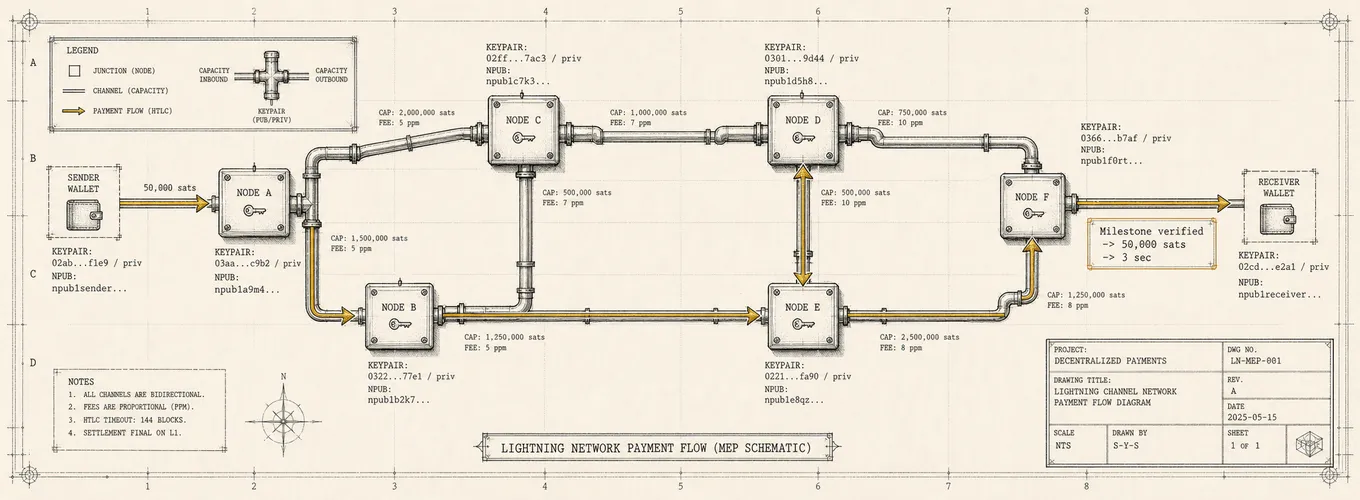
Translate to the industry of 57-to-90-day payment cycles:
Wages without tolls. A worker paid over Lightning receives value in seconds; the World Bank's 6.36-percent average remittance toll (Q3 2025) becomes a rounding error. Payroll providers began settling first salaries over Lightning in 2025 (Bitwage; a vendor claim, but a documented one). For the industry's migrant workforce, this alone justifies the chapter.
Progress payments at progress speed. Where money can move every second, payment can follow work continuously: per milestone, per verified model state, per day, per crane lift. "Streaming money" against signed site records is concept-stage today — no production deployment in construction exists, and this book will not pretend otherwise — but the rail is live, cheap, and open; what is missing is the integration, which is Chapter 8's subject.
Machines with wallets. Lightning payments are small and cheap enough for devices: a sensor selling readings, a router selling bandwidth (working today — Chapter 4's TollGate), an excavator paying for its own telemetry uplink. Machine-to-machine value transfer, impossible on card rails priced in whole percents plus thirty cents, becomes an ordinary engineering component.
Value-for-value. And payments this small change what can be given. A five-cent payment that costs five cents to send is economically absurd; over Lightning it is a "zap" — and around that primitive a genuine culture has grown, called value-for-value (V4V): creators, teachers, and open-source maintainers publish freely and are paid voluntarily, continuously, by the people who benefit. Chapter 6 takes V4V seriously as the economic engine for something construction has been missing for a century: the guild library, the shared knowledge commons, maintained because maintaining it pays.
Now the failure modes, with dates.
Volatility. Bitcoin's price reached 126,198 dollars on 6 October 2025, suffered the largest single-day leveraged deleveraging on record four days later, and traded near 60,000 dollars in mid-2026 — roughly half the peak, eight months on. Anyone denominating a payroll or a contract purely in bitcoin across that period without hedging took catastrophic quote risk. Serious usage today therefore separates functions: pricing in a stable unit, settlement over Bitcoin rails, saving in bitcoin only at horizons long enough to carry the variance — which is precisely the discipline (low time preference) the asset itself teaches. The volatility is real, it is the cost of monetizing in the open, and it has been shrinking across four-year windows since the network began. It is also survivable in a way that a subcontractor's 57-to-90-day unsecured receivable, in a bankruptcy, is not.
Custody is a skill. Keys held by the user mean losses borne by the user: an estimated multi-percent share of all bitcoin is stranded forever in lost keys. Multisignature schemes, hardware signers, collaborative custody, and inheritance planning have matured into an industry, but the skill floor is real and Chapter 9 treats it as a first-class adoption barrier, not a footnote.
Regulation is real. The EU's MiCA regime is fully applicable; anti-money-laundering rules arriving in 2027 will constrain anonymous accounts and impose verification thresholds; the United States legislated stablecoins in 2025 while its broader market-structure law remained stalled into 2026. Chapter 7 maps this terrain properly. The one-sentence version: using bitcoin is lawful across the developed world; serving custody of it to others is a licensed activity; and the drafters of every regime are, so far, consistently more comfortable with businesses that hold customer coins than with software that lets people hold their own — an inversion of risk that Chapter 3 will explain.
Energy is a feature wearing a cost's clothing. Mining consumed roughly 138 TWh/year by Cambridge's April 2025 estimate — about 0.5 percent of global electricity, 52.4 percent of it from sustainable sources, an increasing share bought as flexible, interruptible load that stabilizes grids and monetizes stranded generation. Chapter 7 returns to mining as an energy-infrastructure story, including the corner of it that belongs to this book's own discipline: the mining rig as a building-services component — a boiler that pays for its fuel.
Strip the tribalism away and Bitcoin's offer to the construction economy is four properties no incumbent rail provides together: a savings instrument with fixed supply for the industry's chronically under-capitalized firms and workers; a settlement network that moves value at the speed of the work, across borders, at negligible cost; a scripting layer that lets money make verifiable promises — timelocks, multisignature escrow, atomic conditions; and neutrality — no counterparty who can freeze, reverse, censor, or re-denominate, because there is no counterparty at all.
What it does not offer: price stability on demand, custody without responsibility, or reprieve from regulation. Engineering is choosing trade-offs with open eyes.
"You can't pour a fifty-year foundation on a currency with a four-year memory."
The next question is sharper. Money that nobody controls is only useful if the records of who owes whom, who promised what, who knew what when are similarly uncapturable — and if the people transacting can do so without broadcasting their business to every competitor, criminal, and bureau on earth. That is not a technical aside. It is, as the next chapter argues, the oldest requirement of commerce itself: privacy, understood correctly, as the power to selectively reveal oneself to the world.
C3
Privacy as engineering discipline, not decoration.
In May 2026, Max Hillebrand — free-software entrepreneur, self-described praxeologist and cypherpunk, former CEO of the company behind the Wasabi wallet — published The Praxeology of Privacy, releasing it into the public domain. The book does something this industry-focused volume badly needs: it takes privacy out of the realm of vibes and civil-liberties slogans and derives it, step by deductive step, from the same Austrian economics this book has been using since Chapter 2. This chapter summarizes that argument, then does what Hillebrand leaves to his readers: applies it to a specific industry — ours — where, it turns out, privacy is not a suspect's privilege but the load path of every functioning market mechanism from the sealed bid to the wage packet. Along the way it reports, with case numbers and dates, what happened to the people who built privacy tools in the years this book covers — because that record is part of the engineering reality now.
Hillebrand's first move is definitional, borrowed from Eric Hughes' 1993 Cypherpunk's Manifesto: "Privacy is the power to selectively reveal oneself to the world." The load-bearing word is selectively. Privacy is not secrecy (revealing nothing), not anonymity (revealing acts without identity — sometimes a tool of privacy, not the thing itself), and above all not concealment of wrongdoing. A patient confiding in a doctor is exercising privacy: total disclosure inside a chosen boundary, none beyond it. So is a company sharing its costing model with an auditor under NDA while withholding it from competitors. Privacy is disclosure control — an active capability, not an absence.
The book's architecture rests on three foundations, each an "axiom" in the praxeological sense: a proposition whose denial presupposes its truth.
Action (Mises). Humans act: they select ends and apply means. But deliberation — the weighing of ends before acting — is inherently unobservable and must be: a preference still forming cannot be simultaneously exposed and free. There is a built-in asymmetry between actor and observer; the actor's interior is the one workshop no surveillance can enter without changing what is made there. Privacy is therefore not a preference some people have. It is structural to purposive action itself.
Argumentation (Hoppe). Anyone who argues — including against privacy — presupposes self-ownership: the exclusive control of one's body and mind that makes proposing and disputing possible at all. From self-ownership and legitimately acquired property, the privacy conclusion follows without needing any new "right": "Self-ownership means that what one thinks and what one does are private by default. Intrusion requires justification, and withholding does not." Note what this argument deliberately does not claim: that you own information about yourself. Information is non-scarce — my knowing a fact does not diminish your knowing it — so it fails the test for property (Stephan Kinsella's criterion, which Hillebrand adopts). There is no freestanding "data ownership." There is your skull, your house, your hardware, your contracts — and privacy is what results when those are respected. This matters practically: it grounds privacy in things that can actually be defended (walls, ciphers, agreements) rather than in unenforceable claims over the contents of other people's minds.
Resistance (Voskuil). From Eric Voskuil's Cryptoeconomics: systems can be engineered so that external control costs more than it yields. Privacy in practice is not granted; it is priced in — the result of raising the cost of observation above the observer's willingness to pay. This is the cypherpunk half of the synthesis: strong cryptography is, in economic terms, the cheapest defense curve humanity has ever possessed. Encrypting a message costs microjoules; breaking it costs more energy than stars produce. Defense is cheaper than attack by dozens of orders of magnitude, if the defense is used. Whether privacy exists is therefore, in the end, an engineering decision made by the people who build systems — people like this book's readers.
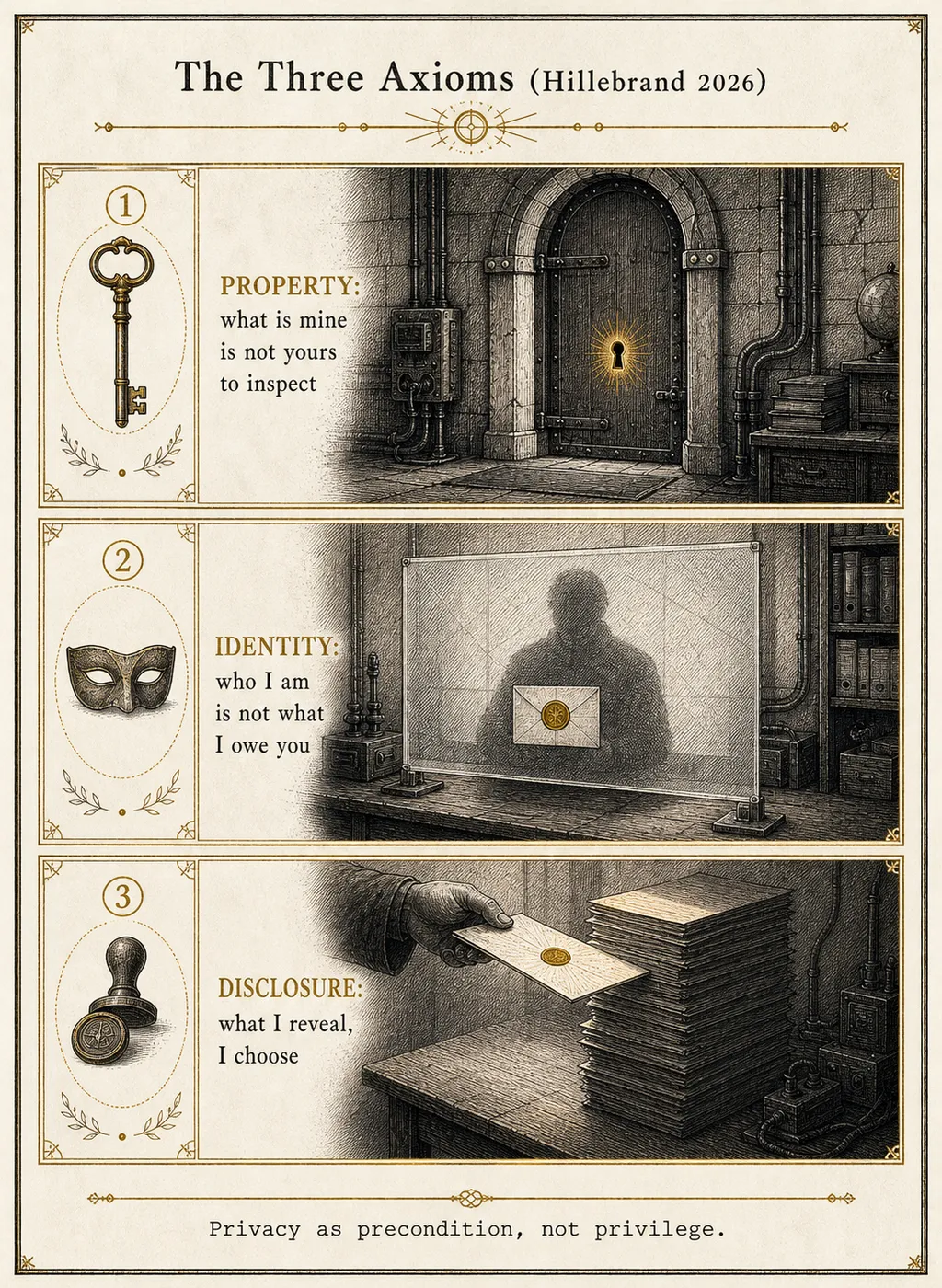
From those foundations, Hillebrand derives the propositions that make this a chapter of an economics of construction rather than a digression:
Surveillance re-imports the calculation problem. Mises proved that central planning fails because it destroys the price signals that carry dispersed, private knowledge. Hillebrand's sharpest observation is that surveillance does the same thing retail: when every actor knows their reservation price, cost structure, and alternatives are visible, they stop revealing them honestly. Prices stop carrying private information. "Transparent negotiation collapses into advantage for the more desperate party." The socialist calculation problem reappears inside every transaction. A market of glass traders is not a freer market; it is a slowly failing one.
Privacy is capital. A costing model, a supplier relationship, a wage structure, an unpatented method — these are capital goods precisely to the degree they are selectively disclosed. Firms understand this instinctively (it is why NDAs exist); Hillebrand gives it theory: the boundary of disclosure is part of the structure of production. Strip it and you have not made the economy more honest; you have expropriated its information capital.
Financial surveillance is triangular intervention. When the state compels banks — and now platforms, wallets, and payment processors — to watch customers wholesale, it intervenes in every exchange between two other parties. The observed pair trades differently, or not at all: marginal trades are chilled first, and the chill is invisible in any statistic because deterred transactions leave no record. And the terminus of the logic is programmable state money — CBDCs — where the buffer between observation and control goes to zero. Hillebrand's summary is the bluntest sentence in the book's orbit: the state cannot steal what it cannot see, and cannot control what it cannot observe — which is precisely why observation is the precondition of predation, and why every regime that intended predation built the observation layer first.
Sound money carries privacy as a fourth function. To the classical triad — medium of exchange, unit of account, store of value — add: store of privacy. Cash bore this function for centuries; every payment rail that replaced it shed the function by design. Fiat in its digital form fails all four. Bitcoin, natively, delivers three — its ledger is public, so privacy must be built on top. Which brings the argument to the tools, and to what happened to their builders.
Hillebrand's Part V catalogs the working stack; readers of this book have met several layers already. On Bitcoin: CoinJoin (many participants compose one transaction, breaking the chain-analyst's input-output heuristics), PayJoin (payer and payee co-sign, poisoning the analytics quietly), Lightning (payments that never touch the public ledger), emerging off-chain designs (Ark, ecash/Chaumian mints — bearer tokens against a mint, auditably blind), each trading trust for privacy at a different point on the curve. For communication: Tor and, stronger, mixnets; end-to-end encryption everywhere; and — the newest layer, co-founded by Hillebrand himself — Marmot/White Noise, running the IETF's Messaging Layer Security (MLS) group-encryption standard over Nostr identities and relays, so that even the metadata rail has no owner. Chapter 4 returns to that one, because a construction project is, among other things, a very large encrypted group chat waiting to happen. And beneath all tools, the practice: threat modeling, compartmentalization, operational discipline — privacy as a verb.
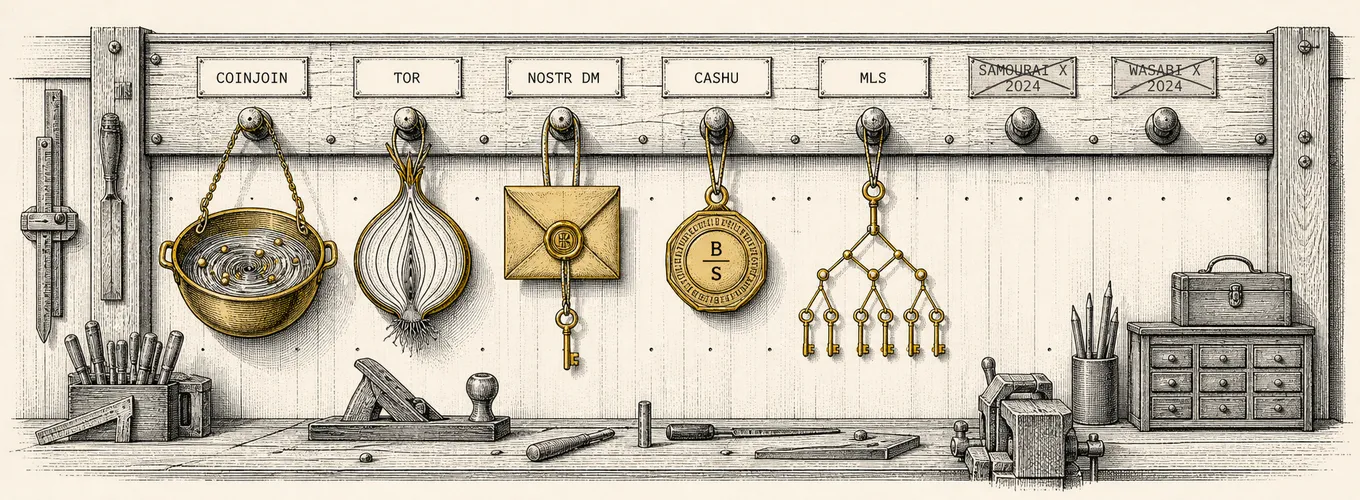
This book promised failures with dates. Here are the ones that define the field's legal terrain.
In April 2024, U.S. authorities arrested the founders of Samourai Wallet, charging that their CoinJoin coordination service constituted unlicensed money transmission. Both pleaded guilty in July 2025; in November 2025 they were sentenced to five and four years respectively. The same week as the arrests, zkSNACKs — the company Hillebrand led — blocked U.S. users and then shut down its own Wasabi CoinJoin coordinator entirely, effective 1 June 2024, citing regulatory uncertainty; the wallet survives as pure self-custodial software with independent coordinators. Roman Storm, co-author of the Ethereum-based mixer Tornado Cash, was convicted in August 2025 on a single unlicensed-money-transmission conspiracy count (the jury hung on the heavier charges), with retrial maneuvering continuing into late 2026. Meanwhile — the same story from the other branch of government — the Fifth Circuit ruled in Van Loon (November 2024) that immutable smart contracts cannot be sanctioned as "property," and OFAC delisted Tornado Cash in March 2025. And in the EU, the AML Regulation taking effect from July 2027 will ban anonymous accounts and privacy-preserving assets at regulated service providers and impose identity verification above 1,000 euros — while the "Chat Control" scanning mandate for private messages was fought to a standstill, its interim legal basis expiring in April 2026 with the permanent regulation still in trilogue as this book went to press.
Read the pattern like an engineer reads a crack map. Punishment concentrates on services — identifiable operators taking custody or coordinating flows. Pure software, self-custody, and self-hosted tools have (so far, in most of the West) held legal ground, and sanctions against mere code were rolled back in court. The regulatory bet, in other words, penalizes intermediation and spares — grudgingly — the sovereign user. The engineering consequence for everything Chapter 8 builds: architectures should minimize the regulable surface — non-custodial, self-hosted, peer-to-peer — not to evade law, but because the law itself keeps ruling that this is the defensible side of the line. It is also, not coincidentally, the side with no honeypot to breach and no operator to subpoena, extort, or acquire.
Now collect the argument and walk it onto the site.
A sealed tender is privacy infrastructure — the textbook case of selective disclosure creating honest prices; a procurement platform that can peek at draft bids, or a data trail that leaks them, breaks the mechanism at its heart. A negotiation — with a client, a supplier, a union — presupposes cards held close; Hillebrand's collapse theorem names exactly what dies when one side's dashboard reads the other's hand. Costing models, BIM object libraries, fabrication details, site logistics plans — Chapter 1 called them the firm's uncounted capital; this chapter supplies the theory: they are capital because selectively disclosed, and every "upload everything to the platform" workflow is an uncompensated transfer of that capital to whoever owns the platform. Wages paid on transparent rails expose workers — disproportionately the migrant workforce — to targeting at both ends of the remittance. Site security is privacy in high-visibility clothing: theft of equipment and materials from European sites is a nine-figure annual loss, and delivery schedules, inventory data, and camera layouts are its reconnaissance. Even safety has a privacy load path: near-miss reporting collapses where workers believe reports are individually traceable — selective disclosure (the report without the reporter) is precisely what aviation's safety culture runs on, and construction's should.
Note what none of these examples involve: hiding wrongdoing. They involve the ordinary confidentiality that markets, negotiations, and professional trust are made of — and that the default architecture of the industry's digital tools quietly deleted. The standards world has even begun to admit it: ISO 19650-5 exists precisely because security-minded information management had to be bolted back onto BIM after the fact.
One caveat belongs here because the rest of this book will rely heavily on signed records: a signature proves origin, not truth. It proves who signed what, when — it does not prove that a measurement was accurate, a calculation correct, or an approval justified. Authenticity is not correctness. The signed record is tamper-evident, not infallible; it still requires calibration, peer review, four-eyes checks, and the professional liability that makes carelessness expensive. What the signature does eliminate is the older, worse failure mode: the unsigned record that nobody can attribute, the revision that nobody can trace, the approval that nobody remembers giving. That baseline — accountable authorship — is what Chapter 8 builds on.
"'Nothing to hide' inverts the burden of proof… the question is not 'why do you need privacy?' but 'by what right do you demand access?'" — Max Hillebrand, The Praxeology of Privacy (2026)
The preceding sections derived a principle; this one names the design pattern it produces — and it is the pattern every subsequent chapter of this book implements without always naming it.
Modern life is not one sphere; it is two. The coercive sphere is the domain of the state and of legal obligation: real names, tax identification, property registers, licensed professions, court-enforceable contracts. It exists because coercion exists, and its instruments — central registries, eID, compliance infrastructure, audit trails — are the correct tools for that domain: where compulsion is in play, accountability must be legible. The voluntary sphere is everything else: social life, private commerce, informal collaboration, creative work, speech, worship, thought — every human interaction that runs on consent rather than compulsion. Its instruments are different because its logic is different: pseudonymous identities, decentralized protocols, local key control, selective disclosure, exit rather than enforcement. The two spheres have always existed; what is new is that the voluntary sphere can now be built — with keys, relays, and protocol-level privacy — instead of merely hoped for.
Between the spheres, a bridge may exist, but its traffic is one-way by design. A builder may choose to link a pseudonymous professional reputation to a legal identity — for a tender, a license, a tax filing. That is selective disclosure in action: the actor decides, the system executes. The reverse — a system correlating pseudonym to real name, metadata to dossier, voluntary act to coercive file — is the precise attack the architecture must prevent. Not by policy, not by promise, but by structure: protocols that do not carry the linkage, keys that do not embed the name, relays that do not log the IP. Architecture over policy is the engineering restatement of the resistance axiom: make the wrong correlation not illegal but expensive — cryptographically, structurally, by design.
The deepest threat is not that one sphere fails but that one colonizes the other. When the coercive sphere's identity logic migrates into voluntary communication — platforms demanding real names for social interaction, analytics correlating shopping and speech, compliance regimes treating every unmonitored channel as a suspect channel — the voluntary sphere ceases to be voluntary. When it works in the other direction — pseudonymous actors evading obligations they legitimately owe, privacy tools laundering the proceeds of coercion itself — the coercive sphere loses the accountability that justifies its existence. Both colonizations destroy the sphere they invade, and both are active today. The regulatory trajectory of Chapter 3's case law is, in structural terms, a fight over where the border runs.
And here the book's own motto sharpens: we don't confront the system — we outbuild it is not a call to secede from the coercive sphere. It is a call to build the voluntary one. No builder can opt out of building permits, tax codes, or professional liability — nor should one pretend to. What a builder can do is ensure that the tools of voluntary collaboration — the guild's internal coordination, the knowledge commons, the value-for-value payments between peers, the reputation that travels with a key — exist on rails the coercive sphere does not own, cannot silently surveil, and need not regulate because no custodian stands in the middle to regulate. The two spheres do not compete. They coexist — the way a building's structure coexists with its services: distinct systems, distinct load paths, connected at defined interfaces, never merged. Every chapter that follows is an exercise in drawing that interface correctly.
The Builder's inspector called the notebook a divergent narrative. Hillebrand's answer, and this chapter's: divergence from the dashboard is not a threat to trust — it is where trust comes from. Verification requires an independent reading, and independent readings require a place the harmonizers cannot reach. Privacy is that place, formalized.
The next chapter is about the network where selective disclosure is not a policy but a property of the wire — where identity is a key, publication is a signature, and the backstage is built in.
C4
Keys, signatures, relays, and records without platform ownership.
Chapter 1 diagnosed a trust gap: the industry's core evidentiary need — who issued what, to whom, when, unalterably — unmet by any platform, as a matter of architecture. Chapter 3 argued that the remedy must be selective disclosure, not radical transparency. This chapter presents the protocol that happens to sit at the intersection, then audits its real state in mid-2026: the payments layer, the encrypted groups, the file and git infrastructure, the machine experiments — and the honest, modest usage numbers. The thesis is deliberately narrow. Nostr is not "the next social network." It is a signature-and-transport standard for statements — and the construction industry is, legally speaking, a machine for producing disputed statements.
An identity is a keypair; the public key (npub) is the name. An event is a small JSON object — pubkey, timestamp, kind, tags, content — hashed and signed. Sign it and it is done: the event is valid forever, independent of any server's opinion. A relay is a server that accepts, stores, and serves events over WebSocket. Clients publish to several relays and read from several; nothing about the set is fixed, and switching costs approach zero. Kinds partition meaning (a profile, a note, a reaction, a long-form article, a calendar entry, a marketplace listing...), and NIPs — Nostr Implementation Possibilities — specify them; clients adopt what they need and ignore the rest.
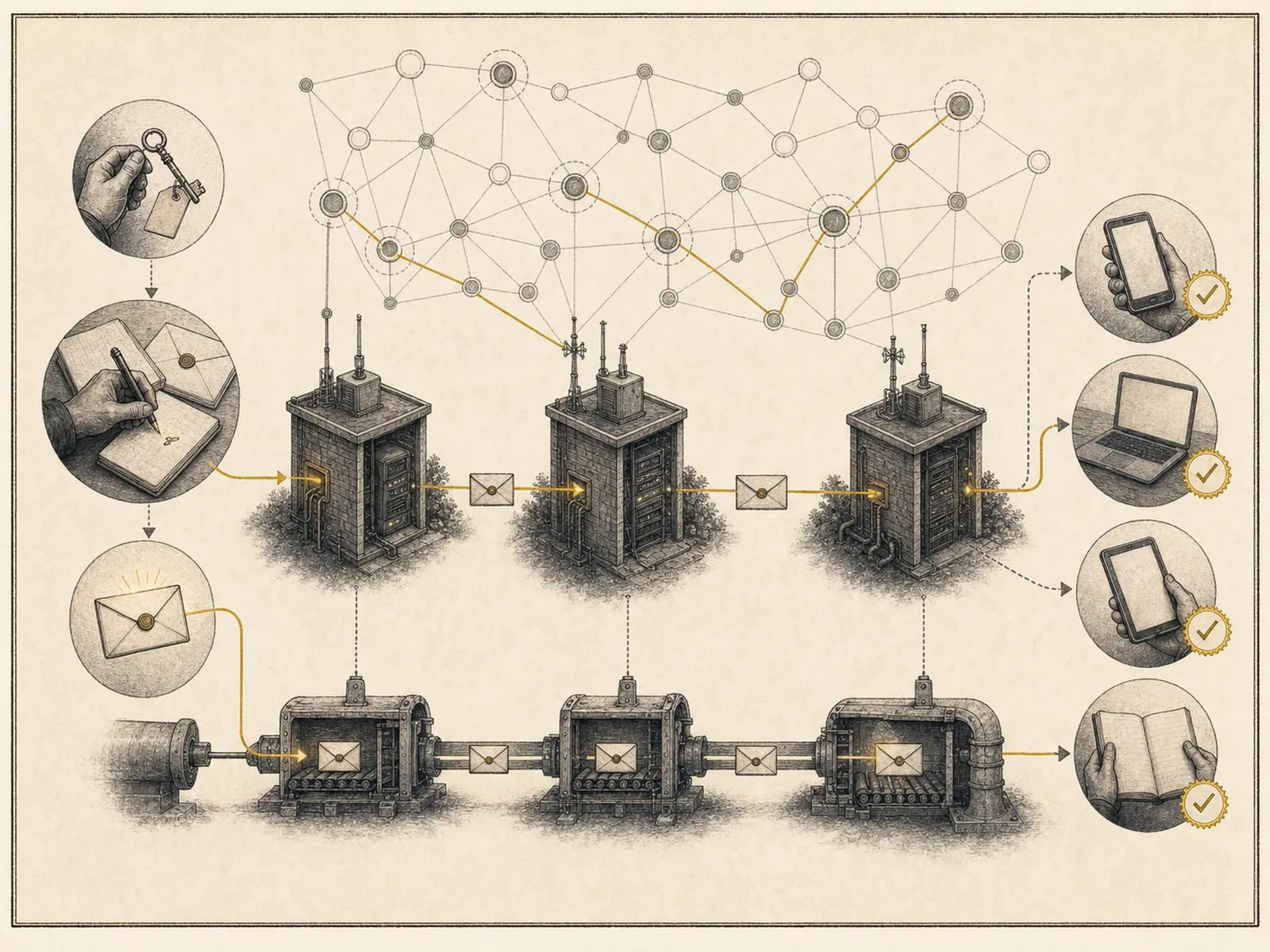
Three design decisions carry the whole argument. Verification is client-side: every reader checks every signature; a relay's honesty is never load-bearing. Identity is transport-independent: followers, reputations, and records attach to keys, so no operator owns the graph. The protocol is dumb on purpose: relays don't interpret content, which is why one wire format serves social feeds, wikis, marketplaces, git — and, if this book has its way, transmittal registers.
Compare the incumbent federation model (ActivityPub/Mastodon): there, your identity lives on a server — your handle includes its name; the server's death or moderation policy is your problem; moving loses your history. Nostr inverts it: servers are stagehands, keys are the actors. For an industry where the median firm has four employees and fifty-year liabilities, "your professional record survives every provider you will ever use" is not a nicety. It is the requirement.
Numbers first, spin never. Public relay monitors counted 950-plus relays across roughly 50 countries in early 2026. An academic measurement study found the average post replicated to ~35 relays, with content surviving the hypothetical loss of the thirty most-used ones — decentralization that is real, if lumpy (default-relay lists in big clients concentrate traffic). Identity spam makes raw account counts meaningless (tens of millions of keypairs exist; most are bots or one-touch tourists); the honest activity metric — daily active trusted users, filtered by web-of-trust — sat around 3,700 DAU (roughly 15,000 MAU), flat through 2025 into 2026 (Glukhov analysis, October 2025; stats.nostr.band snapshots report higher figures depending on filter). Orders of magnitude below Bluesky, let alone the incumbents.
Why does a network that small deserve a chapter? Three reasons. First, funding and shipping cadence are wildly out of proportion to the user count: the OpenSats Nostr Fund has deployed over 10 million dollars in grants since 2023; Jack Dorsey put a further 10 million behind the "and Other Stuff" development collective in 2025; grantees shipped thousands of releases across dozens of clients, signers, relays, and libraries in 2025 alone. Second, the frontier has visibly moved from social to infrastructure — payments, identity, encrypted groups, machine coordination — which is exactly the layer an industry adopter needs, and which does not require anyone's cousin to switch social apps. Third — the Unity Reflect lesson from Chapter 0 — protocols are judged on decades, platforms on quarters. Email was niche for twenty years. The question is not "is it big?" but "is it correctly shaped, and does it survive its operators?" Both answers are yes by construction.
Nostr's payments story is the deepest in any open social protocol, and it arrived in three waves.
Zaps (NIP-57). Lightning payments attached to events — press the bolt, satoshis move from your wallet to the author's, and a signed receipt event appears on the relays. Micropayments with public provenance: the tip jar became a protocol primitive.
Nostr Wallet Connect (NIP-47/NWC). A permissioned remote-control protocol: any app may request a payment from your wallet over relays, within budgets you set. Once built for zaps, it escaped its origin — by 2026 upwards of eighty services speak NWC, and it is quietly becoming what one implementer calls the USB-C of bitcoin wallets: one connector, every app, including — note for Chapter 8 — server processes and AI agents that hold budgets, not keys.
Ecash (NIP-60/61). Cashu — Chaumian mints issuing blind-signed bearer tokens — integrated at protocol level: wallets stored as encrypted events, and "nutzaps" that deliver value as an event, receivable even while the recipient is offline, no Lightning node required. The trade is explicit custody-for-privacy at chosen mints; the significance is architectural: value transfer has become just another event kind. Payment and message are now the same object on the same rail — remember the Chapter 1 complaint that information and cash travel on unrelated rails, and file this as the counter-design.
Around these rails grew value-for-value (V4V) — the practice of publishing freely and being paid voluntarily, per-use, by beneficiaries: podcasters splitting streamed sats among hosts and guests in real time, developers zapped per release, teachers per lesson. Chapter 6 gives V4V its full treatment as the economics of the knowledge commons; here, register only that it exists because the rails made five-cent global payments economically sane.
The protocol's name promised notes and other stuff; by 2026 the other stuff is the story. Encrypted groups: the Marmot protocol runs MLS — the IETF's group-encryption standard, with forward secrecy and post-compromise security — over Nostr identity and relays; its flagship client White Noise (co-founded by Max Hillebrand) shipped on Android and iOS. A project team can now have a group channel with no owner, no server, and cryptographic membership — Chapter 3's theory with an install button. Files: Blossom servers store blobs addressed by SHA-256 hash, with signed user-published server lists and mirroring — content-addressed storage where the hash in the event is the truth and hosts are interchangeable. A BIM deliverable is a blob with a hash; hold that thought. Git: NIP-34/ngit carry issues, patches, and repository state over relays (git clone nostr://npub.../repo), making code collaboration platform-independent — templates, families, and automation scripts are code, and firms share them today through whoever's server happens to host them. Commerce: marketplace listings, P2P exchange (Mostro), app distribution with web-of-trust signing (Zapstore). Wikis, calendars, forms, livestreams — each a kind, each portable.
And at the frontier, the machines. Data Vending Machines (NIP-90): post a priced job request (transcode this, analyze that) as an event; competing providers return signed results for sats — an open compute marketplace with no accounts, thin demand so far, honest label applied. TollGate: consumer routers selling internet access for ecash, coordinating over Nostr events — machine-to-machine commerce running in the field today, routers buying from routers. ContextVM: tool servers addressed by pubkey over relays — machines exposing capabilities without domains, static IPs, or firewall surgery, which happens to describe every sensor, controller, and logger on every construction site on earth. None of this is AEC-specific. All of it is one mapping exercise away — the mapping is Chapter 8.
The audit requires the debit column. Key loss is unforgiving: no password reset exists by design; a lost nsec is a lost identity, and current mitigations — hardware and remote signers ("bunkers," NIP-46), of which audited, rate-limited implementations now exist, plus threshold schemes (FROSTR: split a key k-of-n across devices or officers) — are young. For firms this is Chapter 9 material: key management is an organizational discipline, like safety. Relay economics are unsettled: free relays drown in spam and rate-limit; paid relays fragment reach; the long-term equilibrium (likely: communities and firms running their own — trivial, and for a project consortium actually desirable) is still forming. Concentration is real: default-relay lists and two or three dominant clients recreate soft chokepoints; the escape hatches exist and are used exactly as often as escape hatches usually are. And the culture is a monoculture: the early network skews heavily toward bitcoin circles, which reads as signal or noise depending on the reader. This book's position: the industrial adopter does not need Nostr to win the social war. It needs the protocol's shape — and the shape ships.
Close the loop with Chapter 1's trust gap. A construction project's paper reality — transmittals, approvals, RFIs, site diaries, inspection records, payment applications — is today custodied by platforms that belong to project parties or their vendors, editable by administrators, and lost at access revocation. Map it onto what this chapter established: give every firm, person, and (eventually) machine a key; make every project statement a signed event; carry files as hashed blobs referenced from events; run project channels as MLS groups; route payments — Chapter 2's rail — over the same wire as the records that justify them. The result is not a new platform to buy. It is the absence of a platform: an evidentiary layer that no single party owns, that every participant can independently verify, and where disputes leave a tamper-evident trail — selective disclosure included, because encrypted events and private relays are first-class citizens.
The subcontractor in the vignette, pending review, with three years of evidence behind someone else's login, is the before picture. The after picture is twelve words and an afternoon.
But records and money move people only as far as people are moved. The remaining ingredient of the old cathedral economy was never technical: it was the institution that carried knowledge across generations and made patience a shared identity — the guild. It went missing about a century ago. The next two chapters go looking for it, first in the engines where a new generation already lives, then in the value-for-value culture where, improbably, the guild is being rebuilt.
C5
Shared, persistent models turn drawings into places people can enter.
Every technology in this book so far has been infrastructure — invisible when working. This chapter's subject is the opposite: the most visible, most seductive layer of the stack, and the one whose economics are most misunderstood by the industry buying it. Gaming engines did not enter construction because anyone planned it. They entered because a generation trained itself, unpaid and unsupervised, to build worlds together — and because the tools that generation trained on quietly became better at construction's core task (shared spatial truth) than construction's own tools. This chapter maps what engines actually deliver in 2026, records the sector's most instructive product failure, and sets up the question the industry keeps not asking: what made forty teenagers coordinate for three years without a contract — and can a jobsite have some?
Strip the marketing: a game engine is a real-time simulation kernel — scene graph, physics, materials, lighting, audio, input, and multiplayer networking — engineered to render a coherent world sixty times per second on consumer hardware. Two properties matter for construction. Real-time means conversational: a review meeting can ask "what if the atrium were two metres wider?" and see the answer now, not after a rendering farm's weekend. Multiplayer means shared: the model stops being a file someone owns and becomes a place several people are standing in, which — the vignette's point — quietly abolishes the stale-copy problem that Chapter 1 priced in billions.
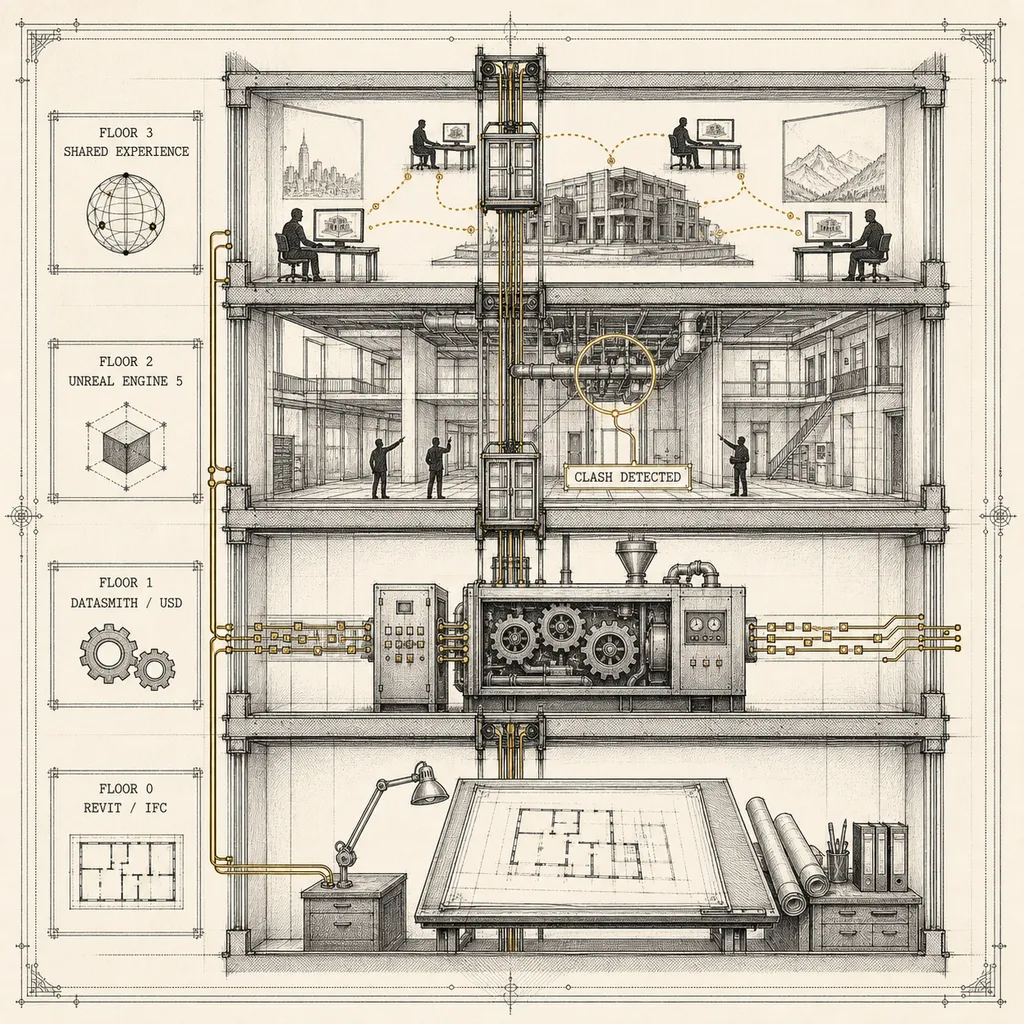
The maturity is recent. Unreal Engine 5 shipped virtualized micro-polygon geometry (Nanite) and fully dynamic global illumination (Lumen), which in AEC translation means: full-detail BIM models, hundreds of millions of polygons, explorable photorealistically without the manual decimation that used to consume visualization budgets. The pipelines industrialized in parallel — Datasmith importers translate Revit, Archicad, Rhino, and IFC with materials and metadata; Twinmotion, Epic's one-click visualization tool, ships bundled with Revit itself. The gap between "authoring model" and "walkable world" has fallen from a specialist's month to a coffee break.
Where engines genuinely earn their keep in 2026: design review in first person — clients and trades catching in minutes what drawing review misses for months (the unreachable valve, the corridor that feels wrong, the maintenance access that exists only in the clash report's imagination); stakeholder and public consultation — a neighborhood walks the proposed school, and the objection meeting becomes a design meeting; training and safety induction — hazard scenarios rehearsed consequence-free, with measured retention gains over slide decks; marketing and pre-sale — the oldest use, still the budget's anchor; and, at the industrial high end, digital twins — live models fed by sensors, where NVIDIA's Omniverse and the OpenUSD format aim at factories, data centers, and districts. Honest label on that last one: the academic reviews through 2025-26 describe twin implementations as "fragmented and uneven," the market forecasts are analyst enthusiasm, and most "twins" in the wild are visualizations with a data feed and a press release.
Now the failure, because it teaches the chapter's law. Unity Reflect — the second-largest engine vendor's dedicated AEC product line, launched 2019 with real adoption — was sunset in 2023, support ended 2024, customers referred to a third-party startup. Nothing was wrong with the technology. The vertical simply didn't clear the vendor's internal bar, so the product died, taking its file formats and workflows with it. Meanwhile Epic's AEC bet continues at Epic's pleasure — genuinely excellent, genuinely bundled, genuinely someone else's strategy. The law: an engine is a rendering dependency, and rendering dependencies are replaceable; data custody is forever. The projects that survived Reflect's death unbruised were those whose source of truth lived in open formats (IFC, and increasingly USD) and whose engine was, correctly, a view. Keep the geometry sovereign — the same instinct Chapters 2 through 4 applied to money, records, and identity — and the engine market's churn becomes healthy competition for your attention instead of a hostage situation. (The open-data route has its own momentum now: Speckle's web-native model streaming raised institutional money in 2024, and three.js viewers put IFC in a browser tab with no vendor at all.)
Here is the statistic that should reorganize the industry's recruiting strategy: the median new entrant to the labor force has logged thousands of hours in built, shared, spatial worlds before their first apprenticeship day — Minecraft (the best-selling game in history, functionally a voxel BIM authoring tool), Fortnite's creative mode, Roblox (whose creator economy paid out over a billion dollars a year to its builders by mid-decade). This is not "kids playing games." It is the largest spatial-reasoning and collaborative-construction training program ever run, financed by entertainment budgets, and its graduates walk onto sites able to read a 3D model the way their grandparents read a newspaper — then we hand them a laser-printed A1 sheet and wonder why recruitment collapses. The engines are the bridge. A firm whose site model is walkable, whose induction is a simulation, and whose as-built record looks like the tools this generation already masters is not being trendy. It is speaking the only spatial language its future workforce is native in — while its competitors post apprenticeship ads written in a dying dialect.
Which returns us to the apprentice in the site office, because the deepest thing engines import into construction is not rendering. It is the social technology that grew inside them.
Look at what that clan actually did, in institutional terms. Forty people sustained a three-year voluntary project. They enforced quality (the sagging bridge came down). They ran design review against reality (the crane-swing lesson). They onboarded novices, transmitted standards, kept a shared artifact alive across membership churn — and they did it for no wage, under no contract, with governance lighter than any site's paperwork. The gaming world calls this a clan or a guild, and the name is not a coincidence: it is a spontaneous reinvention of the institution that built the cathedrals — the lodge, the Bauhütte, the guild — persistent communities of practice that carried skill, standards, and identity across generations, and whose slow death by industrial contract and fiat time-horizon Chapter 1 mourned in statistics without naming.
The engines supplied the place for that reinvention: persistent, shared, ownable worlds where building is the game. What they could not supply — because platforms cannot — is the institution's economic spine: property that outlives the server, reputation that outlives the platform, and a way for knowledge to be paid for without being enclosed behind paywalls that kill the commons. A clan's city dies with the game's servers; a guild's standing dies with a moderation decision; and the master who mentors forty juniors is compensated in nothing the mortgage accepts.
Those three missing pieces — durable property, portable reputation, voluntary value flow — are, respectively, what Chapters 2, 4, and this book's next chapter supply. The engines built the hall. The timechain and the relays can give it a ledger, a memory, and a collection plate. What that combination makes possible — guilds with balance sheets, apprenticeships with provable histories, a knowledge commons that feeds its keepers, and one working proof-of-concept where locked time itself becomes the architecture — is Chapter 6.
C6
Old institutions, new tools, and the missing social spine.
Every chapter so far has repaired a system: money, privacy, records, models. This chapter repairs an institution. The thesis: the construction industry's deepest deficit is not technical but social — it lost the organizational form that once carried its knowledge, standards, and identity across generations. That form was the guild. It is currently being reinvented, artlessly and unpaid, inside gaming clans and open-source projects; and for the first time since its death, the economic rails exist — value-for-value payments, portable reputation, provable commitment — to rebuild it with a spine. This is the chapter the book's motto lives in: we are culture is not a slogan about art. It is a claim about what builders are, and what their institutions are for.
Before the guild became a cartoon of protectionism in economics textbooks, it was the most successful knowledge-transmission institution the building world has known. The medieval masons' lodge — the Bauhütte attached to every great cathedral works — was simultaneously a school, a standards body, a mutual-insurance fund, a certification authority, and a repository of trade secrets held as a commons by the craft rather than as property of any employer. Its curriculum ran apprentice, journeyman, master: years of supervised work, then the Wanderjahre — the journeyman's traveling years, still practiced in the German-speaking world today, in which knowledge circulated between lodges on foot, carried by young people whose only credential was where they had worked and who would vouch for them. Its quality regime was the mason's mark: each cutter's personal sign chiseled into each stone, accountability rendered in the material itself, wages sometimes reckoned against marked output — a signature scheme, five centuries before public-key cryptography, doing exactly what signatures do: bind work to identity beyond dispute. (The reader who has been paying attention since the Builder found a number scratched into a conduit already knows this book considers the mason's mark the oldest protocol in the stack.)
Notice the economics underneath: the guild could only exist under long horizons. Its training investments repaid over decades; its reputation capital compounded across generations; its cathedral projects outlived everyone who began them. It was an institution of, and for, low time preference — Chapter 2's variable, embodied in an organization. And notice what it solved that Chapter 1 measured as unsolved today: knowledge that compounds instead of dispersing at each project's end; quality bound to identifiable craftspeople instead of to liability-shielded corporate shells; newcomers formed inside a community of practice instead of consumed as interchangeable labor.
The guild died of many causes — industrial deskilling, the state's absorption of certification into licensing, the corporation's replacement of the craft community with the employment contract. But its slow suffocation tracks the shortening of civilization's time horizon, and the money is not innocent: institutions that live on decade-scale trust do not survive well in an economy whose unit of account loses meaning on decade scales. We did not merely change how builders are paid. We changed what kinds of institutions can afford to exist.
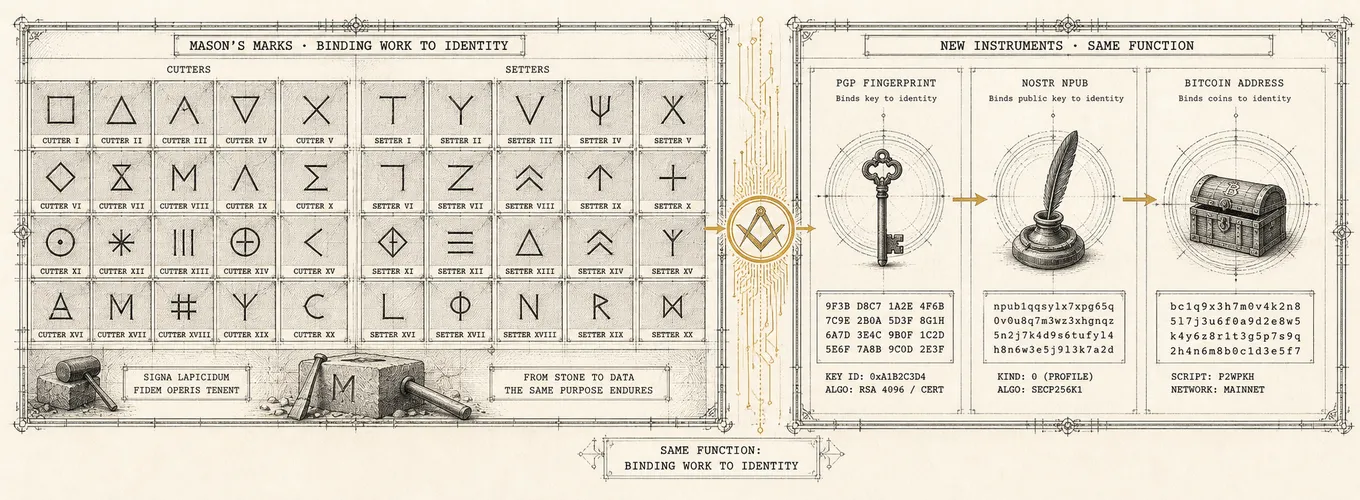
Chapter 5 left forty teenagers running a three-year voluntary construction project with quality enforcement and structured mentorship, and named them: a guild, spontaneously reinvented. The pattern generalizes far beyond one clan. The great open-source projects — the software this book's entire stack runs on — are guilds to the letter: apprenticeship by pull request, mastery by review, reputation as the currency of authority, the commons defended by license instead of lodge oath. Wikipedia is a scriptorium guild. The Bitcoin and Nostr developer ecosystems, funded by grants and donations, are guilds with treasuries. Humanity, offered networked abundance, keeps rebuilding the same institution — because the problem it solves (transmitting hard skill through voluntary community across time) never went away.
The author can report from the inside. In 2005, on a European server called Frostwolf, forty members of a guild called Holyfreaks entered Molten Core — a raid dungeon the game had designed to be unbeatable without disciplined coordination. One player, the group's quiet MVP, had spent days farming fire-resistance potions and distributed them to all forty before the pull. Ragnaros fell because one person's preparation became forty people's survival — and because the other thirty-nine trusted the call, held their roles, and stayed out of the fire. It was guild economics to the letter: voluntary contribution, shared risk, collective memory. And as the giant's story predicts, the carry was temporary. No single shoulder holds forty people's weight forever; the guild that lasts is the one that turns the MVP's knowledge into everyone's discipline.
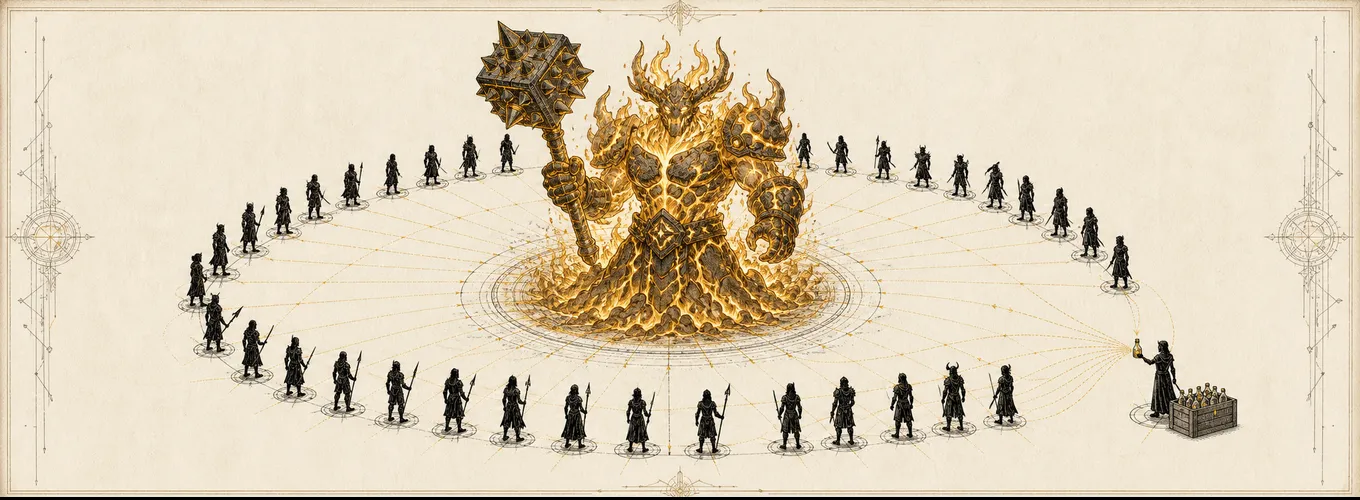
But the digital guilds share the flaw the apprentice named without self-pity: they build on rented ground. The clan's city dies with the server. The forum dies with the platform's pivot. The mentor's reputation is a row in a database that a moderation queue can zero. And the economics run on volunteer burnout garnished with advertising — the knowledge is free precisely because the people maintaining it are unpaid, which is why so much of it decays, and why the paywalled alternative encloses what should be commons. The guild form found its way back. Its property rights and its payroll did not.
Until, quietly, the rails from Chapters 2 and 4 supplied both.
The term value-for-value (V4V) comes from the podcasting world: publish freely, ask listeners to return value voluntarily — and, decisively, make the returning effortless. The Podcasting 2.0 project turned the idea into open infrastructure: a value tag in the feed itself declares Lightning splits (this share to the host, this to the guest, this to the app), players stream satoshis per minute of listening, and "boostagrams" attach messages to lump payments. On Nostr, the same economics run as zaps (NIP-57), splittable the same way, with public receipts. No paywall, no ad broker, no platform tax, no minimum viable audience — a teacher in the smallest niche on earth can be paid by seventeen grateful practitioners on four continents, five cents at a time, and the payment costs what a payment should: effectively nothing.
Read V4V through the Austrian lens and it stops looking naive. Value is subjective and marginal (Chapter 2): the person best placed to price a lesson is the person whose problem it just solved, after it solved it. Conventional pricing forces valuation before use, behind a wall that excludes precisely the students, the poor, and the merely curious — the guild's future members. Advertising resolves the dilemma by selling the audience's attention to a third party, which is how the internet's knowledge commons became a surveillance estate (Chapter 3 priced that). V4V is the third mechanism: post-hoc, voluntary, marginal, and honest — it monetizes gratitude rather than access or attention. Its ceiling is real (free-riding is structural, and the podcast pioneers publish their modest numbers), but its floor is revolutionary: the commons can now have an income without acquiring an owner. OpenSats — the grant fund from Chapter 4, moving millions of donated dollars to open-source maintainers — is V4V at institutional scale: patronage, the oldest funding model of the Bauhütte era, rebuilt on rails that settle in seconds.
Now apply it to this industry. Construction's knowledge commons is in permanent artificial famine: the detail library that would save a thousand firms a thousand redundant hours sits siloed in each firm's server (Chapter 1's incentive gap — the sharer bears cost, the commons reaps value, so nobody shares). The fix was never exhortation. It is plumbing: publish the detail, the family, the calculation template, the lessons-learned memo under your seal (authorship provable, Chapter 4), let usage return sats automatically (V4V splits, this chapter), and let the record of what your published work carried build your reputation (next section). The Bauhütte's secret was never secrecy — it was that the craft owned its knowledge and the knowledge fed the craft. That loop, severed by a century of work-for-hire, is mechanically reconnectable now.
Assemble the pieces the digital guilds lacked:
Property that survives the server. The clan city was a database row; a guild's artifacts can now be signed events and content-addressed files (Chapter 4), replayable from any relay, owned by keys, deletable by no platform. The apprentice's three years need never again reduce to a screenshot.
Reputation that walks. The journeyman's book of vouchers — who trained under whom, who attested what — is a chain of signed statements between keys: attestations, in modern dress. Not a certificate issued by a platform, but a history verifiable against the public record of actual published work, actual zapped lessons, actual co-signed projects. Portable across every employer, every app, every border, for a working lifetime. For an industry that runs on references and vouching (every site hire begins with "who did you work with?"), this is the credential system it always meant to have.
Commitment that can be proven. And the guild's deepest asset — its long horizon — gets, for the first time, an instrument. Chapter 2 introduced the timelock: money provably immobilized until a chosen future block. A guild treasury locked for a decade is a constitution written in script — no officer can raid it, no faction can vote it into this quarter's budget; the institution's low time preference is no longer a virtue asserted but a fact on the timechain, verifiable by any apprentice deciding whether this community is worth their formative years. Proof-of-patience as an institutional credential. Which brings us to the strangest and most instructive artifact in this book — the proof of concept where all of this is already running, disguised as a game.
Full disclosure, in the spirit of this book's honesty rule: the case study is the author's own project, built with collaborators in the Bitcoin and Nostr ecosystem, and presented here not as a success story — it is a working proof of concept, not a shipped product — but because it is the most complete existing implementation of this chapter's thesis: a social world whose entire economy is guild economics.
600 Billion is a digital palace of culture built on exactly two protocols. Its design law is one sentence: Bitcoin proves the time; Nostr owns the object. There is no token. (An earlier design carried a sidechain for objects; it was removed when the team admitted the scarcity was never coming from the token — it was coming from locked time — and that ownership was already a signed event-chain. The redundant layer, "a federation wearing the costume of a feature," was deleted. Sovereign-stack minimalism, practiced.)
The core mechanic is Chapter 2's timelock, made playable. A player locks sats — their own, returning in full at unlock — and the lock births an object that grows over the lock's real duration: twenty-one days of patience earns a hand-painted seal-tile whose pattern derives from the lock itself; 2,100 hours, first wheels; 210 days, a companion; twenty-one months, a tree that adds real annual rings; twenty-one years — a generation, locked and witnessed by the most secure clock humanity operates — a spaceship. The ladder's law: "Money buys style. Time builds legend." Cosmetics cost small sats; status is purchasable only with time, cannot be farmed, faked, or bought secondhand off someone else's patience, because the provenance chain (signed instance and transfer events on Nostr, anchored to the lock's outpoint) is public and replayable by anyone. It is low time preference as a game loop — Hoppe rendered in a raccoon-mascotted world — and, the designers argue, the first status system in gaming whose scarcity is not vendor-printed but physical.
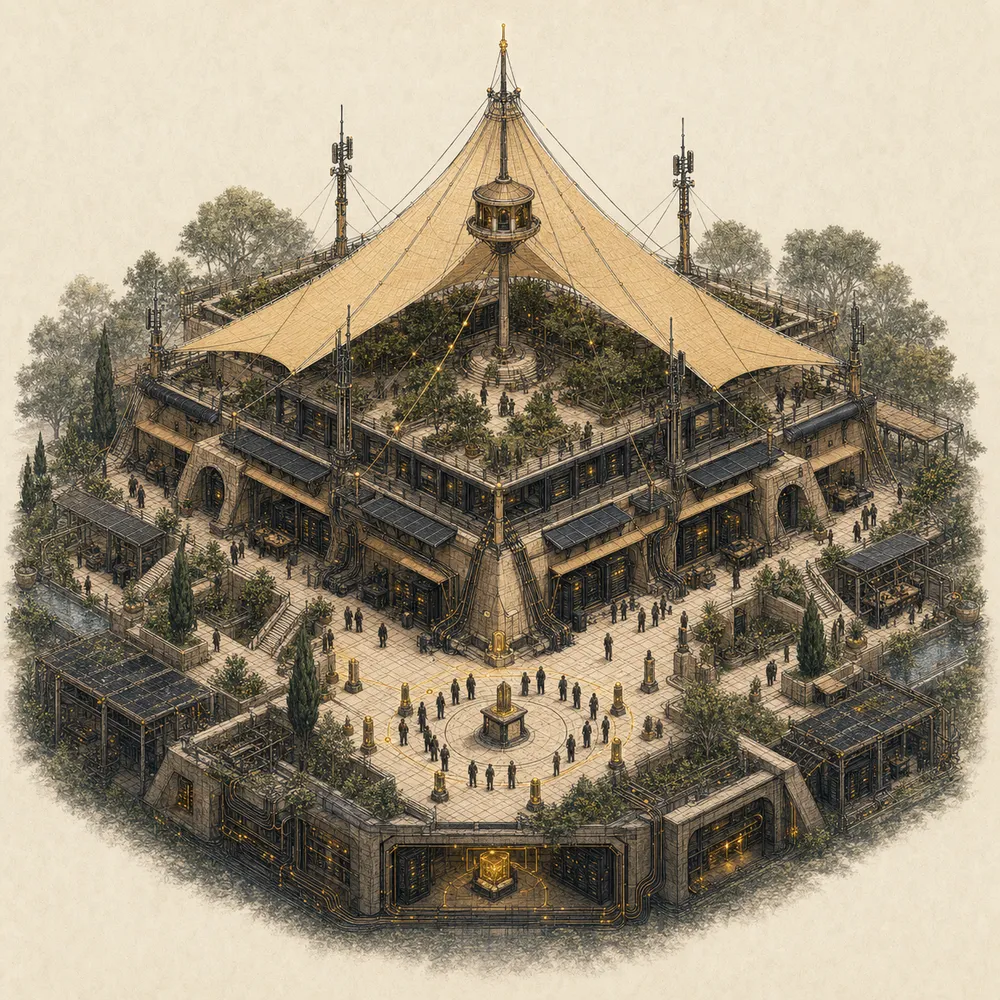
The social architecture is the guild map of this chapter, deliberately. At the world's center stands the global Palace of Culture (its model, the reader of this book's acknowledgments will be unsurprised to learn, began life as a Revit model and traveled a BIM-to-engine pipeline of the exact kind Chapter 5 described). Each country gets one national palace — founded only when twenty-one players are active, its first twenty-one remembered permanently: founder as an earned, dated, provable role, the digital equivalent of names chiseled in a cathedral's foundation course. A palace grows no way except through its community — new halls, gardens, monuments appear as its people contribute; "there are no progress bars; the architecture itself is the progress bar." Guild halls, libraries, and stages are its organs; guilds and "groves" reach shared goals and unlock shared works. And the palace's building law is pure commons governance: the Palace is decorated by everyone and built by no one — private homes are each player's sovereign sandbox, but the shared monument accepts only finished, owned work, placed. The economy on the stages is V4V end to end: live music events stream in over Podcasting 2.0 feeds and Nostr live-event kinds, artists are paid in streamed sats and boostagrams and zaps, makers sell real work peer-to-peer for sats — a community-owned creator economy with no platform take.
Two details make this a construction book's case study rather than a curiosity. First, the project's own development runs under ISO 19650 discipline — the BIM standard's common-data-environment states (work-in-progress, shared, published) govern its assets and even its architecture decision records; the game's player-facing building loop (private drafts at home; validated, owned objects published to the shared palace) is a CDE workflow wearing festival clothes. The loop closed: construction's information-management standard, exported to a game, teaching a generation CDE discipline as play. Second, the posture: non-custodial throughout ("the app is the cartographer, not the king" — it renders what Bitcoin and Nostr prove and custodies nothing), identity as user-held seals with privacy treated as a safety requirement, and every object recoverable from public relays if every server the project runs disappears. Chapter 3's legal analysis, Chapter 4's architecture, implemented by a building-services engineer, in the open.
What does it prove, in the cold light this book insists on? Not market success — that verdict is years away. It proves composition: that timelocks, event-chains, V4V rails, engine worlds, and guild structure snap together into one coherent, running system, built by a tiny team without permission, custody, or token — and that the result is not a financial product but a place, with founders, festivals, patience, and memory. The cathedral guilds would have recognized every part of it except the physics.
And the rebuilt guild is not only digital. As this book went to press, the author's own drawing board held its physical counterpart: a concept, in development with a South Tyrolean market town, to revive a disused historic chapter house — empty since 1930 — as a Klosterwerkstatt: a monastery workshop in the literal, medieval sense of the word, updated by exactly one move. Apprentices there would learn the crafts and the instruments — timber and point clouds, stone and models, tradition and technology as one curriculum rather than two camps — because the region's building trades are starved for exactly the young people Chapter 5 found asleep in the materials container. The financing logic is deliberately guild-like rather than grant-like: private-first, carried by industry partners who gain an apprentice pipeline, a showroom, and a stake in the region's capability, with public programs joining once the model runs — patience capital, not subsidy dependency. Beside it, in the same quarter, a youth and culture hall in a repurposed Alpine bunker: thick walls, long horizons, loud music — the clan given a building. The project's two working mottos belong in this chapter's margin, untranslated: „Wer das Handwerk verlernt, verliert die Heimat." Who unlearns the craft, loses the homeland. „Wer neue Werkzeuge nicht nutzt, verliert den Anschluss." Who refuses the new tools, loses the future. The cathedral guild had both sentences carved somewhere too, in whatever their century's dialect was; every living guild does.
The phrase this book keeps returning to can now be said precisely. Culture is the capital that guilds accumulate: knowledge, standards, stories, marks, monuments — the compounding residue of people building together longer than any project pays them to. Chapter 1 measured what its absence costs; this chapter located the machinery of its return. Builders were never merely labor plus logistics. The lodge, the mark, the wandering years, the palace hall raised by its own community — we are culture: the sentence is a claim of ownership, and for the first time in a century, the deed can be held in twelve words.
But guilds, like everything else in this book, exist inside jurisdictions, energy grids, and monetary regimes — and those are moving. Before assembling the full reference architecture, the tour must go wide once more: to the states now stockpiling the money, regulating the rails, and rediscovering, in datacenter heat and strategic reserves, that they too are downstream of the timechain. Geopolitics, next.
C7
Money, law, and energy have become construction terrain.
No builder needs convincing that distant policy arrives on site: rate decisions become dead cranes, tariffs become steel prices, sanctions become rerouted supply chains. This chapter maps the specific terrain the book's tools now inhabit — because between the first draft of this book (2024) and this edition (mid-2026), the state stopped ignoring the timechain and started positioning around it. The map below is dated deliberately; nothing ages faster than geopolitics, and a serious book says "as of when" in every paragraph. Three layers: the money moves, the law, the energy. Then what it means for a mid-sized European building firm, which is the only question this book is actually obliged to answer.
The headline event came on 6 March 2025: a U.S. executive order established a Strategic Bitcoin Reserve, capitalized with bitcoin forfeited in criminal and civil proceedings, under an explicit no-sell policy, with agencies directed to find budget-neutral ways to acquire more. Executive action, not statute — codification bills were still pending in Congress as of mid-2026 — and the disclosed numbers moved around in ways that themselves teach a lesson about official data: a White House adviser put holdings near 328,000 BTC in early 2026, while independent on-chain estimates had run as low as 198,000, the gap reflecting the unglamorous distinction between seized and finally forfeited. Verify, don't trust, applies to treasuries too.
The pattern below the headline is more instructive than the headline. The Czech National Bank — a central bank inside the EU — bought a small test portfolio including bitcoin in late 2025, then declined (February 2026) to add it to formal reserves while its governor kept publicly arguing the case: institutions probing, hedging, disagreeing with themselves in the open. Bhutan, which had quietly mined against its stranded hydropower for years, spent 2025-26 selling most of its stack to fund development projects — a reminder that a reserve is only a reserve until a budget needs it. El Salvador, the first mover, settled into an uneasy détente with the IMF: its loan agreement capped further public bitcoin buying, while the reserve nonetheless drifted upward amid methodological disputes about what counts as buying — state adoption, like state data, arrives with an asterisk. Pakistan announced reserve-and-mining ambitions and promptly met its own IMF's objections to subsidized power. The composite picture as of mid-2026: no stampede, but an irreversible reclassification. The asset that was a punchline in 2021 is now a line item states argue about keeping — and the arguing is done in the vocabulary of gold: reserves, custody, audits, no-sell covenants.
The monetary backdrop explains why the option stays on every table. U.S. gross federal debt passed 39 trillion dollars by mid-2026 with net interest around one trillion a year and rising on official projections; the dollar's share of global reserves drifted to about 57 percent (from ~73 percent at the century's start); central banks bought gold near record pace for a fourth year — by one measure gold passed U.S. Treasuries as a share of central-bank reserves for the first time since 1996 — and survey after survey of reserve managers pointed the same direction: away from unhedged exposure to any single sovereign's promises. De-dollarization rhetoric (BRICS currencies and the like) remains mostly rhetoric — local-currency settlement grows incrementally; no common currency exists; the viral statistics are unverifiable — but the hedging is real, and bitcoin now sits on the menu of hedges, state-grade. Meanwhile the CBDC track advanced in exactly the opposite spirit: the ECB moved its digital euro toward pilots (potential issuance toward the decade's end, legislation pending), while the U.S. banned federal CBDC work outright — one bloc building programmable state money, the other forbidding it, both confirming Chapter 3's analysis that the battle is over who observes and controls the ledger.
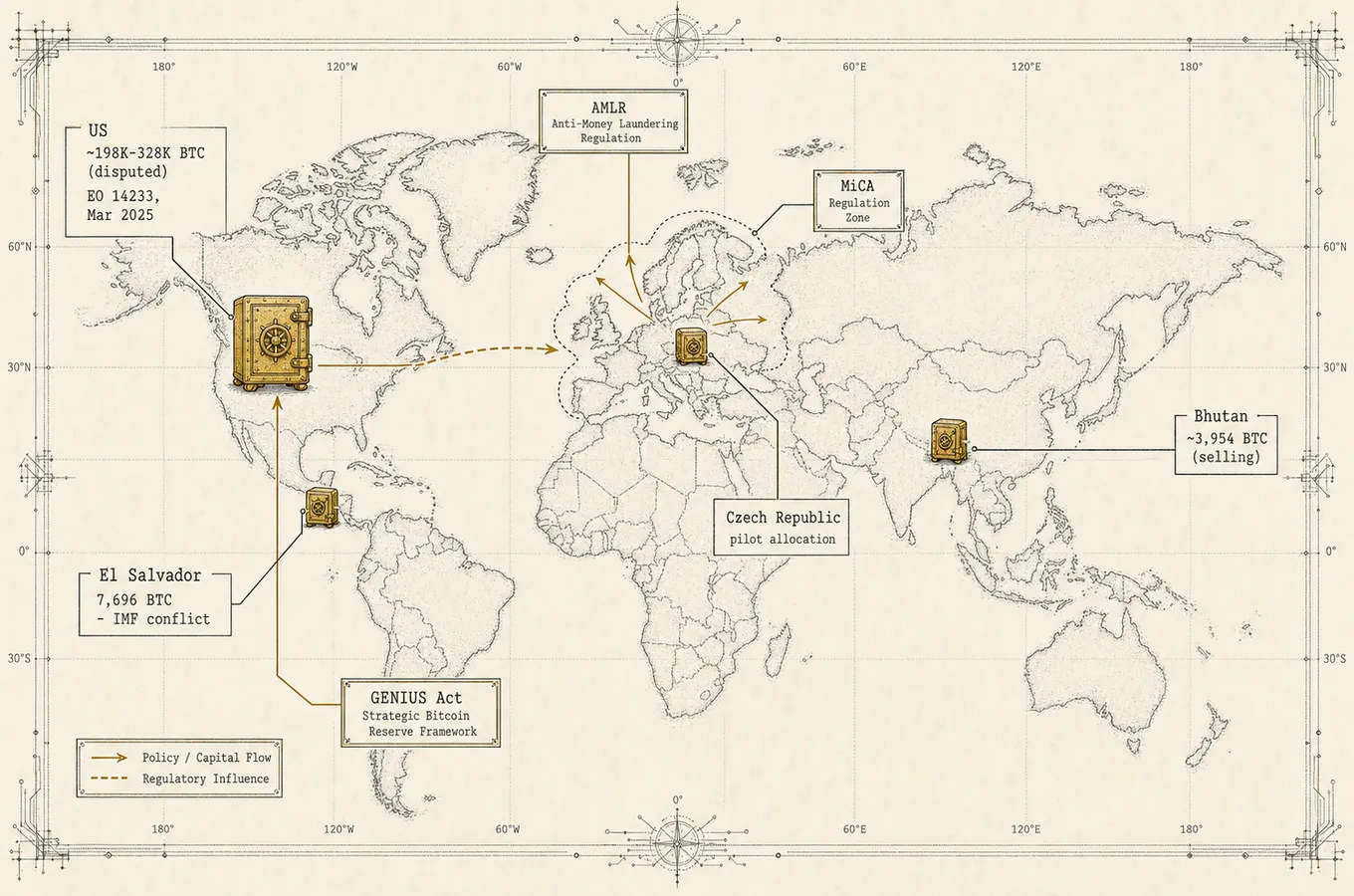
For the European reader, three regimes define the operating environment. MiCA — fully applicable since 30 December 2024, national transitions ending mid-2026 — created the EU's licensing system for exchanges and custodians: a compliance regime for service providers, with a couple hundred firms authorized by mid-2026 and non-compliant products (notably the largest offshore stablecoin) delisted from regulated venues. The AML Regulation (AMLR), applying from July 2027, is the one to diarize: no anonymous accounts at regulated providers, no privacy-preserving assets on their shelves, identity verification for transactions above 1,000 euros — while self-custody itself remains legal, with due-diligence friction at the on/off-ramps. And Chat Control, the proposal to mandate scanning of private communications, was fought to legislative exhaustion — its interim legal basis expired in April 2026 with the permanent text still deadlocked — the clearest demonstration yet that the surveillance default does not pass unopposed when engineers, and voters, read the drafts.
Across the Atlantic, the U.S. legislated stablecoins (July 2025) — first federal digital-asset statute, banks and licensed issuers only, full reserves — while broader market-structure law stalled; the prosecutions and the sanctions rollback covered in Chapter 3 (Samourai sentences, Storm's contested conviction, Van Loon, the Tornado Cash delisting) fixed the practical frontier: intermediaries are regulable, published code keeps winning, and the space between is where careful architecture lives. The strategic read for a firm, compressed: the compliant path exists and is boring — licensed providers for the fiat edges, self-custody for treasury, non-custodial rails for operations — and the design instinct from Chapter 3 (minimize the regulable surface, hold your own keys, prefer software over services) is not just philosophy; it is the demonstrated safe harbor of five years of case law and two regulatory regimes.
The third layer belongs, at last, to this book's home discipline. Bitcoin mining consumed roughly 138 TWh/year by the Cambridge Centre's April 2025 estimate — about half a percent of global electricity, 52.4 percent of it sustainably sourced by their accounting, with the U.S. hosting the largest share of hashrate and a long tail from Paraguay's dams to Ethiopia's grid surplus. Two properties make mining unlike any load an energy engineer has met. It is perfectly interruptible — seconds to zero, no ramp costs, no storage decay — which is why Texas grid data shows gigawatts of mining acting as demand response, paid to vanish during peaks (one large miner earned over 30 million dollars in curtailment credits in a single quarter of 2025); a fleet of reverse peaker plants, financing renewable overbuild by monetizing the hours nobody else wants. And it is location-indifferent — the only industrial buyer that goes to the energy rather than demanding the energy come to it: flare gas, stranded hydro, curtailed wind, all convertible to a globally liquid asset at the wellhead. The 2026 twist: hashrate growth paused (first quarterly decline in six years) as miners pivoted sites and substations toward AI datacenters — the two great electron-hungry industries now bidding against each other for the same interconnects, with mining increasingly the flexible layer wrapped around AI's inflexible base load.
For the HVAC engineer, one more property outranks all of the above: a miner converts electricity to heat at essentially 100 percent, while earning revenue. A resistive heating element that pays for its own electricity is not a metaphor — commercial products already heat Nordic district-heating loops, greenhouses, pools, and apartment blocks with hashboards; at building scale the arithmetic works wherever heat demand, electricity price, and noise abatement align. Honest label: niche today, economics hash-price-dependent, integration unglamorous. But this book was written by someone who sizes heating plants, and the idea of Abwärme mit Einnahmen — waste heat with an income statement — belongs in every low-temperature design study from here on. The wire that carries the timechain's security budget terminates, sometimes, in a radiator.
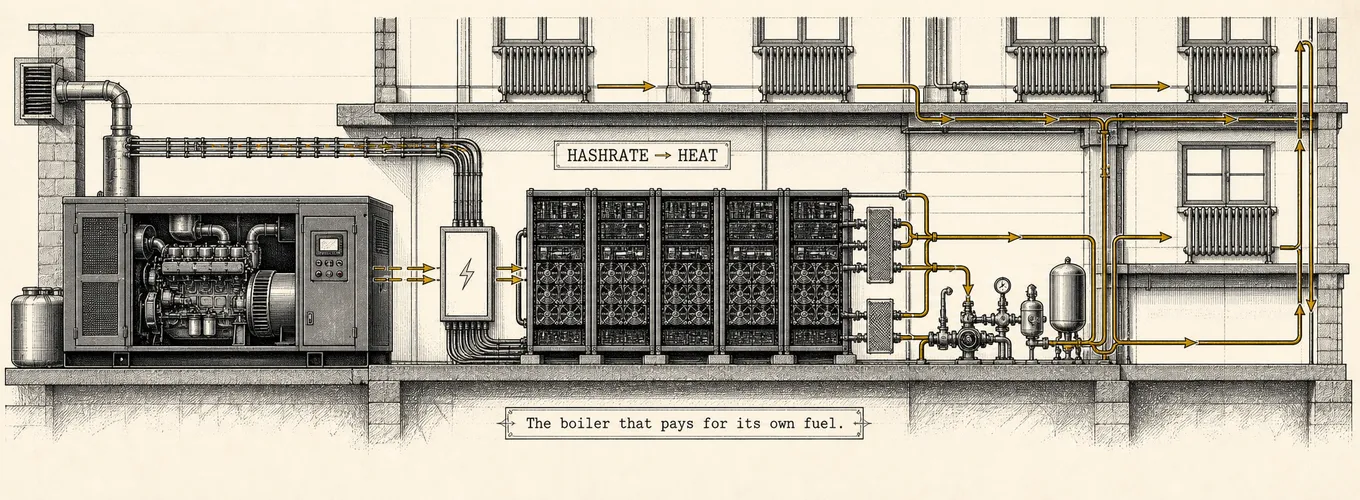
What does the map mean for a European building firm, mid-2026? Monetary regime change is real but slow — plan in decades, not headlines: the fiat system is not ending Tuesday; it is being hedged against by its own administrators, which is both the permission slip and the timetable for private hedging (Chapter 2's treasury discipline). The legal environment rewards exactly the architecture this book proposes — self-custody, non-custodial rails, published protocols — and penalizes improvised intermediation; AMLR's 2027 arrival belongs in every affected firm's compliance calendar now. Jurisdiction is a design parameter — relays, mints, coordinators, and keys can live where law is clearest, a freedom the industry's physical assets never had; the building-code metaphor is operational advice. And energy strategy just acquired a new component — interruptible, revenue-bearing load is a tool in the same kit as thermal storage and peak shaving, occasionally shaped like a boiler.
The pieces are now all on the table: the diagnosis (Chapter 1), the money (2), the confidentiality (3), the records (4), the shared world (5), the institution (6), and the terrain (this chapter). What remains is the drawing set — the reference architecture that assembles them into a working construction ecosystem, and an honest bill of quantities for building it. That is Chapter 8.
C8
A reference architecture for an open construction record layer.
Every preceding chapter delivered a component. This chapter is the assembly drawing. It specifies, layer by layer, how a construction project — or a firm, or eventually an industry — runs on open protocols: identity, records, models, money, compute, and governance, composed into what this book has been calling an open construction ecosystem. Two ground rules govern the design. Nothing herein requires anyone's permission, platform, or token — every layer uses running, open-source, self-hostable technology as of 2026. And nothing herein is fantasy: where a layer is proven we cite it, where it is a pilot we say pilot, and where it is unbuilt white space we mark it as this book's proposal — because as the research for this edition confirmed, nobody has yet assembled these pieces for AEC. The white space is the opportunity.
Every participant gets a Nostr keypair: each firm, each professional, each project, and — deliberately — each machine that produces evidence (the total station, the flow meter, the crane logger). Human-readable naming via NIP-05 binds keys to existing trust anchors (m.huber@firm.at resolving from the firm's own domain), so verification piggybacks on DNS and reputations firms already own. Corporate keys are held organizationally — threshold schemes (FROSTR-style k-of-n) so no single laptop or single officer is the company; per-project delegation via remote signers ("bunkers"), so a project lead signs for the firm on this project only, revocably. The mapping to existing practice is direct: ISO 19650's appointing/appointed-party roles become key relationships; the commissioning body's audited, rate-limited signer is the digital version of the company stamp drawer. None of this requires new standards — only the discipline (Chapter 9) of treating keys like calibrated instruments.
Every statement that today lives in a portal becomes a signed event: transmittals, approvals, RFIs and answers, site-diary entries, inspection results, delivery notes, meeting minutes, payment applications. Project-defined event kinds mirror the industry's existing exchange semantics (BCF issues, transmittal schemas), so the innovation is not the vocabulary — it is the custody. Events publish to a small redundant relay set: one relay run by the client, one by the lead contractor, one by an independent third party (the guild, Chapter 6; or a professional body; or a paid archive service) — three basements, no single owner, the Builder's four-minute dispute as the design outcome. Confidentiality is not an afterthought: sensitive streams run as MLS-encrypted groups (Marmot), tender phases use encrypted events with selective disclosure at award, and Chapter 3's theorem — the sealed bid as market infrastructure — is enforced by cipher rather than policy. The result is the industry's oldest legal need, met structurally: an audit trail that no party administers, ISO 19650's golden thread with the thread held by mathematics instead of a vendor's export function. Where a record must survive not just tampering but doubt about its date — a construction diary entry, a claim notice — the event's hash is additionally anchored into Bitcoin itself via OpenTimestamps: a timechain notarization that costs fractions of a cent and outlives every registrar. This layer alone — signed transmittals on neutral relays — is the minimum viable adoption, deployable this quarter by any two firms that agree to try.
Files — IFC models, drawings, calculations, point clouds, USD scenes — live as content-addressed blobs (Blossom-style: the SHA-256 hash is the identifier), mirrored across the same three-basement topology as the relays. The transmittal event references the hash; the hash is the revision. Datenverlust between phases (Chapter 1's 15.8-billion-dollar wound) is addressed at the root: the as-built record is not whatever survived the handover — it is the accumulated, signed, hash-verified issue history, walkable backward from any point in the asset's fifty-year life. Authoring tools keep working exactly as today (this is critical: no plugin religion); the open formats — IFC 4.3 for semantics, USD for scenes — carry between silos, and the engine layer (Chapter 5) renders views of the same hashes, so the walkable model and the contractual model can never quietly diverge. Version-controlled scripts, templates, and families ride git-over-Nostr, shareable across the guild library with V4V splits attached (Chapter 6): the knowledge commons, plumbed.
Payments run on the rails of Chapter 2, bound to the records of Layer 1. Milestone escrow in multisignature (client, contractor, neutral third key — the guild again, or an insurer): funds visibly committed at contract, released on signed evidence (the pressure test event, the inspection approval), unreleasable unilaterally, and — where the milestone is future-dated — provably time-locked: retention money that demonstrably exists and demonstrably releases at defect-liability expiry, ending the industry's quietest theft (Chapter 1: retention as involuntary subordinated lending). Wages and subcontractor flows over Lightning: seconds-final, cross-border at negligible cost, the 6.36-percent remittance toll deleted for the workforce that pays it. Machine flows for the long tail: sensors selling calibrated readings, site routers selling connectivity (TollGate's pattern, running today), the vending-machine terminal from the vignette — a building answering paid queries about itself for the price of a coffee. Where quote-risk matters (it does; Chapter 2's honest section), pricing stays in euros and settlement rides sats, or MiCA-regulated stable instruments handle the bridge — the architecture is agnostic about the unit and opinionated only about the rail: money and evidence on the same wire, so that payment latency collapses to verification latency. That single design decision attacks the 299-billion-dollar slow-payment tax at its mechanism.
The open-compute pattern (NIP-90 DVMs, and its successors) gives projects a spot market for machine work: post a priced job — clash-run this federation, energy-simulate this variant, render these views, OCR this delivery archive — and let competing providers return signed results for sats. The guild's specialist members become service endpoints; the lone Fachplaner with the best simulation rig in the region earns from it at 02:00 without a sales department (ContextVM's pubkey-addressed tool servers make even NAT-jailed site hardware reachable without firewall surgery). Honest label from Chapter 4 stands: demand on these markets is thin in 2026, and AEC demand is zero because AEC hasn't arrived yet. But the shape — jobs and results as signed, paid events on the same rail as everything else — is the first compute-market design that fits an industry of four-employee firms: no enterprise agreement, no per-seat license, pay per job, reputation by verifiable history.
Protocols carry facts; institutions carry judgment. The architecture reserves its human layer for the guild (Chapter 6): operator of the neutral relay and the escrow tiebreaker key, registrar of attestations (who trained whom, who vouches for what), curator of the shared library, and — borrowing the dispute-resolution insight from Hillebrand's parallel-economy chapters — first-instance arbiter whose rulings are themselves signed events, building precedent. Not a company, not a platform: a treasury (timelocked, Chapter 6), a membership of keys, and bylaws that live in the same repository as everything else. Where existing professional bodies are willing, they can be this layer — the architecture is indifferent to whether the guild is new or five hundred years old, only to whether its records verify.

This chapter's architecture is not a thought experiment; it is the distilled specification of a pilot the author has under development, called Gemeinwert (public brand) / BIM-CVP — the Common Value Protocol for signed openBIM coordination records. Its design documents make three choices worth reporting because they answer the three objections practitioners raise first.
It builds nothing that exists. The pilot's first principle is verbatim: we build only the glue. Relays are stock open-source relay software; blobs live on standard Blossom servers; signing runs through existing signer apps; Lightning through existing account software; IFC parsing through the open toolchain; model viewing through open web components; timestamping through OpenTimestamps. What the pilot itself defines is only the event vocabulary: a kind registry mapping openBIM artifacts one-to-one onto signed events — BCF topics, viewpoints and comments; IFC file references; ISO 19650 document records; approvals up to multi-signature plan releases; and, pointing at the industry's next decade, records for life-cycle assessment (EN 15804/15978), life-cycle cost (EN 16627), EU Level(s) indicator sets, maintenance cycles, and deconstruction-plan approvals with reuse targets — the circular economy, which runs on exactly the thing this architecture provides and buildings never had: a trustworthy material memory. The registry deliberately becomes a standards proposal only after multiple real projects have validated it — protocol discipline, learned from the NIP process.
It meets the industry where it stands. The pilot's second principle: the target user has had the same email setup for fifteen years and is not wrong. No key material in the interface — a "create your character" flow, not a cryptography lesson (the fitter's nine seconds, designed in from day one). And crucially, export adapters push published record states outward to the incumbent platforms, so a firm can adopt the sovereign layer without asking any counterparty to leave their CDE: graceful degradation as a first-class feature, not an apology.
It shares one primitive with the palace. The ownership mechanism — an append-only chain of signed events proving custody and transfer — is the same code that tracks objects in the 600 Billion world of Chapter 6: one primitive, two worlds, developed once. A game asset and an as-built model turn out to want the identical guarantee: provenance that outlives every server it ever touched. That convergence, more than any argument in this book, is the evidence that the stack beneath both is general.
What exists and is proven, as of this edition: every protocol named above, running in production somewhere — none of it in AEC at scale. What exists as pilots and adjacent evidence: academic smart-payment prototypes reporting real coordination-time savings; Lightning payroll in production at the payments vendors; content-addressed model sharing in the open-source AEC world; the 600 Billion proof of concept composing the full stack in a cultural setting. What is white space, now being surveyed by the pilot above: the AEC event vocabulary (drafted, in testing), the escrow templates married to inspection evidence, the guild layer, the vending machine. What failed and taught: the tokenized-construction wave of the late 2010s (the instructive pivot: the sector's best-funded "blockchain construction" startup quietly became an AI workflow company — the market rewarded boring automation, not chains); Unity Reflect (platform custody dies); zkSNACKs's coordinator (services are targets; protocols survive). The architecture above is drawn to those lessons' specifications: no token, no platform, no custodian, no single basement.
Two objections deserve their answers in advance. "This is just another IT project." No — it is smaller than one. Every layer degrades gracefully to current practice (the PDF still prints; the bank transfer still works); adoption is per-artifact, not big-bang; the minimum deployment is two firms signing transmittals, which costs less than the meeting that decides against it. "Nobody will hold keys." The fitter signed in nine seconds and never asked about elliptic curves. Key ceremony is an interface problem, and the interface problem is being solved by an ecosystem with, per Chapter 4, rather more funding than users. The genuinely hard parts are elsewhere — organizational, legal, cultural — and they get the next chapter, undiluted.
Ship the crypt.
C9
The honest bill for keys, law, volatility, and adoption order.
Advocacy books end with a vision. Engineering books end with a punch list. This chapter is the punch list: every material barrier between the reference architecture of Chapter 8 and its adoption, with current mitigations and residual risk stated. The list is short but heavy — keys, law, volatility, and people — plus the industry-specific frictions (procurement, liability, data protection) that any AEC deployment meets in the first month. None is a reason to wait. Each is a reason to start small, deliberately, and in the right order.
The unforgiving fact from Chapter 4 stands: self-sovereign keys mean self-borne loss, and an industry of four-employee firms cannot staff a cryptography department. The mitigations have matured into a practical stack — hardware signers for individuals; audited remote signers with rate limits and tamper-evident logs for firms; threshold schemes (k-of-n across officers or devices) so no laptop, death, or resignation is the company; timelocked inheritance and recovery paths for the long tail of human events. But tools are the minor half. The major half is procedure: key ceremonies, succession planning, revocation drills — the same organizational muscle the industry already exercises for site safety and for the company stamp. The correct mental model, offered seriously: treat keys like calibrated instruments — inventoried, checked on schedule, with named custodians and documented chains. Firms that manage torque wrenches can manage nsecs. Residual risk: real, permanent, and smaller every year — and asymmetric in the right direction, because the alternative (platform custody) concentrates the same risk in someone else's basement with someone else's incentives.
Chapter 7 drew the map; the adoption consequences compress to four lines. Self-custody and non-custodial rails are lawful across the developed world and are the demonstrated safe side of five years of enforcement. The fiat edges — exchanges, custody services — are licensed territory: use regulated providers there and the compliance burden becomes their product. The EU's AMLR (from July 2027) adds identity friction at those edges and belongs in affected firms' compliance calendars now. And public procurement cannot require exotic rails — so the architecture enters public work as what it is at Layer 1: signed records and neutral archives, procurement-neutral, offering the client better evidence rather than asking the client for anything. One further legal texture is AEC-specific: GDPR versus permanent records. The rule of thumb that resolves it: personal data never enters events — events carry hashes, pseudonymous keys, and pointers; the personal layer stays in conventional, erasable stores. Immutability for evidence, erasability for persons. The two regimes compose cleanly if designed for from day one — and catastrophically if retrofitted.
The February fitter counts his October sats twice: that is the adoption barrier as experienced. The discipline from Chapter 2 answers it without ideology. Operations price in euros; rails carry value; nobody holds quote-risk involuntarily or unknowingly. Firms hold bitcoin, if at all, as long-horizon treasury — sized so that a 50-percent drawdown (which happened, again, within this edition's writing) is an accounting event, not a payroll event. Escrow and retention structures denominate obligations contractually and hedge the bridge. And workers choose their split at payday, with the default conservative. The barrier dissolves not when volatility ends (it will not, for years) but when exposure becomes elective at every node — which the architecture, correctly built, makes it.
The heaviest line item has no software patch. Chapter 1's dysfunctions are, for their incumbents, equilibria: float earns interest; opacity wins claims; the dashboard's fiction is somebody's KPI. The “these things drift” problem — decent people rationally defending indefensible systems because the sentence is cheaper than the implications — yields to exactly one force, and it is not argument. It is demonstration at the margin: the fitter paid before his van leaves the yard; the four-minute dispute; the subcontractor whose evidence survives access revocation. Diffusion in this industry has always run trade-to-trade, site-to-site, Stammtisch-to-Stammtisch — which is why Chapter 8's minimum deployment is two firms and a transmittal, and why Chapter 6's guild is not a nostalgic ornament but the adoption vehicle itself: institutions of practitioners, spreading practice, at the speed of vouching. Education rides the same rail — the engine-native generation (Chapter 5) learns CDE discipline inside game worlds (Chapter 6's case study runs ISO 19650 states as play), and every apprentice so trained is a future site where the architecture is the familiar option. Time horizon for the people problem: a career, not a quarter. Time preference, as ever, is the variable under everything.
Punch lists end with sequence. For a firm: start at Layer 1 (signed transmittals between two willing partners — cost: an afternoon), add content-addressed deliverables on the next project, pilot one milestone escrow with a client who has been burned before (they will not need persuading), and only then touch payroll, treasury, or vending machines. For a guild or professional body: stand up the neutral relay and the attestation registry — the infrastructure of trust is your historical mandate wearing new clothes. For the individual reader: twelve words, an afternoon, one signed site diary — the pilot project is you. What must not be done: big-bang platform replacement (the architecture's entire advantage is that it never requires one), custody improvisation (use the stack), or evangelism ahead of demonstration (the tired defenders outnumber you; show, don't tell).
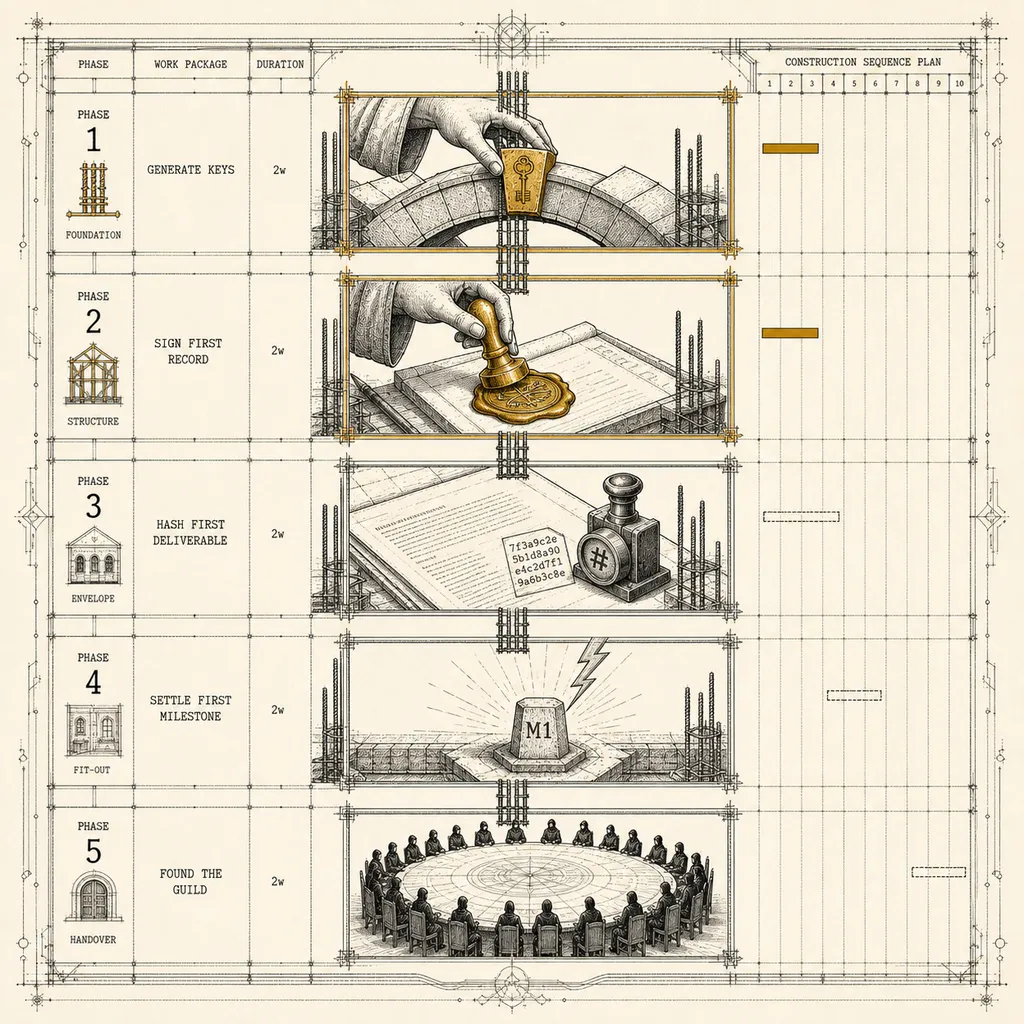
The list was named, line by line, and none of the lines said impossible. They said discipline, sequence, patience — which are, it will not have escaped the reader, the industry's own oldest virtues, the ones the cathedral crews had before the tools arrived to deserve them again. What remains is to look up from the punch list, once, and describe the building this has all been for.
C10
What changes when builders own the instruments they depend on.
The first edition of this book closed with a vision of 2054, and this edition keeps faith with it — inhabitants co-creating their cities in immersive worlds, modular assembly from fabrication hubs, buildings as ecosystems, value-driven urbanism — while holding it to the standard the intervening years taught: visions are cheap; trajectories are earned. So this final chapter does three things a serious book owes its reader at the door: it extrapolates only from components demonstrated in the preceding chapters; it names what would falsify its optimism; and it ends with assignments rather than applause.

Project the demonstrated components forward a decade and the composite scene needs no miracles. Records: signed, content-addressed project histories become ordinary first as dispute insurance, then as procurement advantage, then as the client's default expectation — the golden thread, held by mathematics. Money: settlement latency collapses toward verification latency on the projects that choose it; retention and escrow become visible, timelocked facts; the payment-delay tax — 299 billion dollars a year in one country's vendor survey — becomes a number historians check twice. Models: the walkable twin and the contractual record converge on the same hashes; the stale-copy dispute joins the fax machine in the museum of process archaeology. Institutions: guilds — some newborn, some five centuries old and re-instrumented — run the neutral layers: relays, attestations, libraries, arbitration; apprentices accumulate portable, provable histories from their first signed diary entry. Energy: interruptible, revenue-bearing load sits in the standard HVAC toolkit beside thermal storage; the security budget of the world's neutral money terminates, unremarkably, in radiators. And the culture: the generation that learned CDE discipline inside game worlds — that founded palaces at twenty-one keys and locked patience into spaceships — arrives on real sites carrying guild expectations as defaults. None of this is prophecy. Each line is a Chapter 1-through-9 component plus compounding.
What would falsify it — the book's own instrument check, offered for future readers to hold against it: a protocol capture (Nostr's relay layer consolidating into a de facto platform; Bitcoin's neutrality compromised by hashrate or law); a legal reversal that criminalizes self-custody in major jurisdictions rather than regulating its edges (the current trend is the opposite, but trends are not laws); or simple non-adoption — the equilibria of Chapter 9 outlasting a generation of demonstrations. The author weighs these risks as real, unequal, and survivable, in that order — and notes that every one of them argues for more builders in the arena, not fewer.
Assignments, by role — each one small enough to start this week, chosen so that its value survives even if every larger hope in this book fails.
The engineer or architect: generate a keypair; sign your next site diary or calculation note; publish one detail, one family, one lessons-learned memo under your seal to wherever your peers will find it — with a V4V address attached, not for the income but for the precedent. The BIM manager: hash your next milestone deliverable and record the hash in the transmittal — one line of process, the entire Layer 2 in embryo; put the walkable model in front of the trades and watch who speaks up who never spoke before. The contractor: pilot one milestone escrow with one burned-before client; pay one willing crew's bonus over Lightning and time it. The owner or facility manager: demand the as-built as a verifiable record, not a USB stick of orphaned PDFs; you are the party the 2004 interoperability study identified as paying most for the status quo — act like it. The professional body or guild elder: stand up the neutral relay; open the attestation registry; you have been the trust layer for centuries — claim the instrumented version before someone rents it to you. The apprentice: you already know the worlds; learn the keys; the industry that seems closed to you is about to need exactly what you are — and this time, what you build will not be wiped.
Everyone: take one real reading, of anything, and write it down. That is where the Builder started.
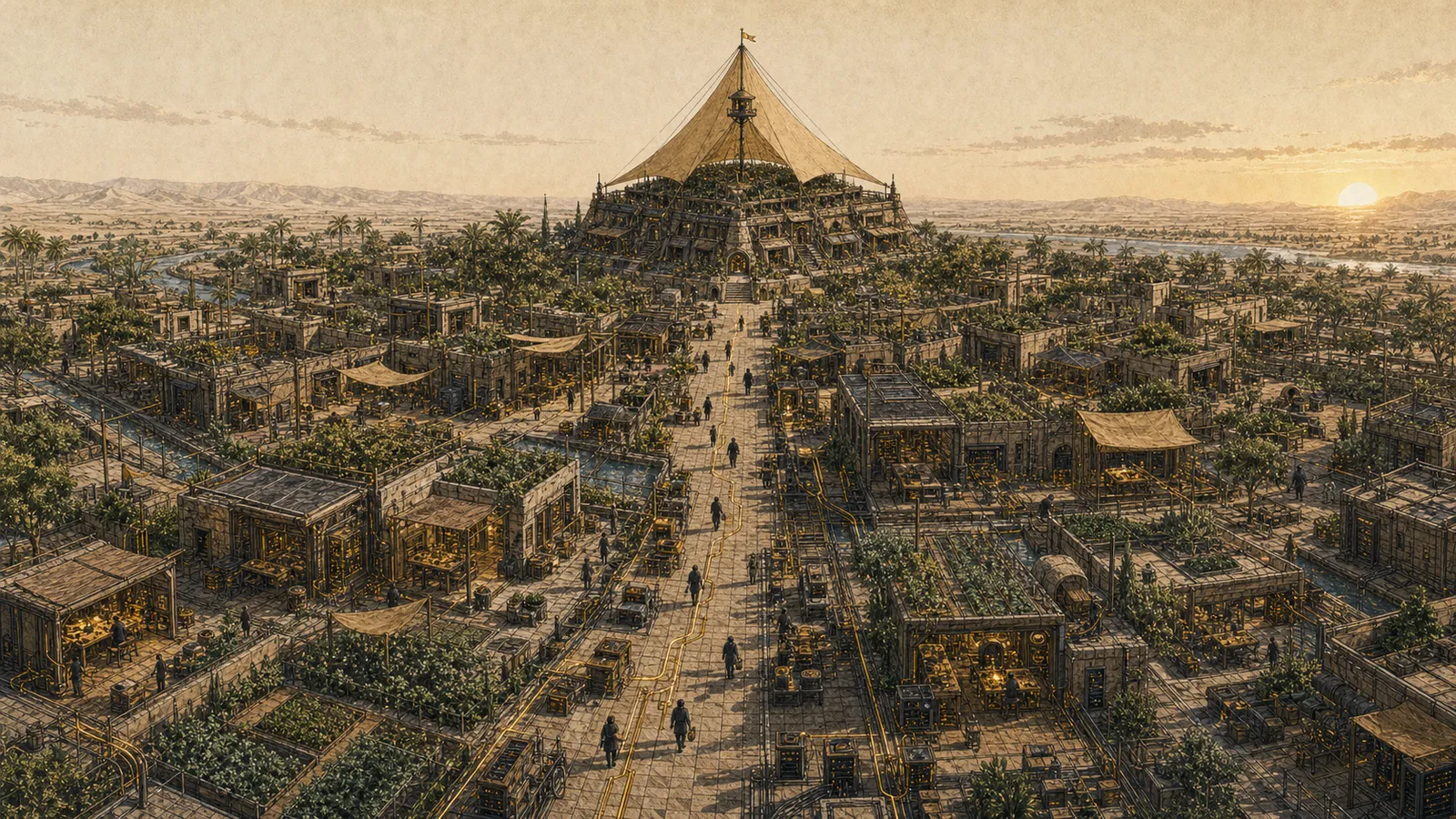
Strip the book to its beams. An industry that builds everything, trusted with civilization's fixed capital, has been running on borrowed instruments: money that cannot hold a measurement, records that cannot survive their custodians, models that cannot be shared, institutions that cannot remember. The repair kit turned out not to be an industry solution at all, but the general-purpose sovereignty stack — verifiable scarcity, verifiable statements, shared worlds, voluntary value — built in the open by people who mostly never poured a footing, waiting for the builders to notice that who issued what, to whom, when and hold no opinion, carry the load were their requirements all along.
The cathedral crews had it right, and the numbers from Chapter 1 are the receipts of forgetting: we did not lose productivity; we lost the institutional memory that productivity compounds in. Sound money made long horizons affordable; the lodge made them inheritable; the mark made work accountable; the guild made knowledge a commons that fed its keepers. Every one of those has been rebuilt now, in software, with better instruments than the masons dared want — and the first palaces are already standing, in worlds and on hills, founded by people twenty-one keys at a time.
We are culture. Not consumers of it, not employees inside it — the thing itself, walking around in work boots: the species' habit of building what outlasts the builders. It was never the towers that made that true. It was the trade at the bottom of everything, the one the Builder named on the hill — an honest reading, given and kept, compounding across generations until it has a skyline.
The numbers don't match. They never match on their own. And the system that mismatches them will not be argued out of it — it will be outbuilt, the way it has always been outbuilt: one honest reading, one signed record, one paid lesson, one founded guild at a time.
We don't confront the system. We outbuild it.
Go make them match.
S
The workshop, the number, and the load-bearing sources.
The figure who opens every chapter of this book lives in a city of this book's own making — a city where the dashboards are green, the instruments disagree, and a small network of people decides that the disagreement is a place to build. Its furniture returns from chapter to chapter like details from one drawing set: the workshop in the district between two spreadsheets, the marks scratched into conduit, the frequency at 04:20, the stones, the notebooks, the adjustments with their conversion ratios. Its cast walks these pages unnamed — an operator, an economist, a cryptographer, a supplier, an apprentice — because the Builder's world keeps names the way it keeps keys: private by default. And the story has no ending, only a rule: there is always a next person who finds the number.
The number is also a place — and the architecture is also a repository. Chapter 8's reference design is being built in the open as Gemeinwert / BIM-CVP, the Common Value Protocol for signed openBIM coordination records; Chapter 6's guild has a physical sibling in development, a Klosterwerkstatt in a South Tyrolean chapter house. Both are early, both are honest about it, and both welcome collaborators — signed, of course.
And one thing is missing deliberately. Readers from the author's own field will notice that the circular economy — buildings as material banks, deconstruction as harvest, the closing of the material loop this industry owes the century — appears in this volume only as foundation work: the material memory in Chapter 8's record kinds, the deconstruction approvals with their reuse targets, the guild that keeps knowledge alive longer than any building stands. That is not an oversight. It is load order. A circular economy runs on exactly one scarce input — trustworthy memory of what was built, out of what, by whom, and in what condition — and this whole volume existed to build the rails that memory needs. Part II — The Circle will stand on them: material passports as signed events, the building as a verified material bank, deconstruction as the guild's second harvest. This book ends where every honest structure ends: at the level where the next one can bear.
600 Billion exists as a proof-of-concept world — the digital palace of culture described in Chapter 6, built on Bitcoin timelocks and Nostr provenance, where patience grows into trees and spaceships and every national palace remembers its first twenty-one. Its home is www.600.wtf. Its design papers, its architecture decisions (kept, like all good construction documents, in ISO 19650 states), and its code are open. If this book argued anything, it argued that builders should inspect load paths themselves: the world is there to be walked.
Why 600 billion? These pages never explain the number, and neither will this afterword — except to note what the Builder noticed in Chapter 1: it is nobody's mystery. It is somebody's arithmetic. Every reader who has ever added up what the confusion actually costs — on a project, in a currency, across a working life — has scratched some version of it into some conduit somewhere.
We don't confront the system — we outbuild it: the founding law of the workshop is also this book's strategy, and it is older than the book; every parallel institution in history, from the lodge to the free city, was built beside the thing it replaced, not against it. And we are culture — the phrase the workshop uses as greeting and the founding's last word — is the book's entire thesis in three words, and it is meant literally. Culture is not the decoration on top of an economy. It is the compounding memory of people who build together longer than any single project pays them to: the guild's library, the mason's mark, the palace hall, the honest notebook. Money that keeps its promises, records that keep their signatures, and worlds that keep their doors open are not three technologies. They are one act of remembering.
This book was written by a building-services and BIM engineer, in the evenings, in the conviction that the people who make the physical world deserve instruments as honest as their work. It was drafted with the assistance of research and writing tools, and every load-bearing claim was checked against the sources listed below the old way: by reading them. Errors that survived are the author's. Corrections, arguments, and better readings are welcome — signed, of course.
FLX — Tirol, July 2026 flx@600.wtf · www.600.wtf

All sources were accessed and verified June–July 2026. Estimates, vendor surveys, and contested figures are labeled as such in the text where they appear. This list is selective; it contains the load-bearing citations.
Standards referenced throughout: ISO 19650-1/-2/-3/-5, ISO 16739-1:2024 (IFC 4.3), RFC 9420 (MLS), BIP-65, BIP-340.
This work is licensed under the Creative Commons Attribution-ShareAlike 4.0 International License. To view a copy of this license, visit http://creativecommons.org/licenses/by-sa/4.0/.
Curated source lanes for the book spine, physical systems, and Bitcoin economies.
Book spine
Turn the book roadmap into a reproducible framework: anchor selection, legal structure, assets, and operational playbooks.
Local money
Collect real places where Bitcoin is used for payments, savings, education, and merchant onboarding.
Physical stack
Balance monetary sovereignty with the material stack: homes, tools, workshops, land, water, and energy.
Open Source Ecology becomes the physical toolkit: machines, build docs, material systems, and outbuilding infrastructure.
OSE integration
Start with the Global Village Construction Set, then pull out the machines that matter first for a citadel site: building shell, earth blocks, lumber, fabrication, welding, water, power, and repair.
Open Source Ecologycivilization toolkit
OSE frames the whole physical stack: 50 open-source industrial machines for a small, modern civilization.
building system
Owner-build housing with CAD, bill of materials, build notes, utilities, PV, and replication docs.
materials
Produces compressed earth blocks from onsite soil and is one of the most mature OSE construction machines.
materials
Turns local logs into lumber, reducing dependence on outside supply chains.
fabrication
Digital fabrication tool used to cut parts for other machines and workshop infrastructure.
fabrication
Welding is the repair and machine-building bottleneck for a serious workshop.
water
Water access determines whether a site can become an anchor rather than a retreat fantasy.
site work
A serviceable tractor is the basic multiplier for earthworks, hauling, farming, and workshop logistics.
Citadel is a home of craft by hand, helped by machines when machines are the right tool.
Hand first
The machine stack is useful only when it strengthens local skill. This library separates open wikis, open design systems, free field guides, and FOSS design workflows so each guild can build from sources that are traceable.
Large sustainability wiki with construction, earthen construction, shelter, wood, and wood-working categories.
Indexes adobe, mudbrick, CEB, earthbag, rammed earth, cob, and other soil-based methods.
CNC-cut timber blocks for modular, high-performance buildings with repeatable assembly logic.
Modular ecological housing library linked to OSE, with house parts and build workflow thinking.
Free-software architecture, engineering, construction, OpenBIM, FreeCAD, BlenderBIM, IFC, and QGIS knowledge.
DIY plans for solar heating, passive solar, water heating, greenhouses, conservation, and small renewables.
Small-scale technology briefs and drawings across shelter, water, energy, food, and livelihoods.
Shared-grid modular construction system where parts can be designed, reused, repaired, and recombined.
Reusable drilled-beam system for furniture, workbenches, small structures, and fast analog prototyping.
Distributed furniture model for downloadable, locally fabricated plywood desks, tables, and fixtures.
Free CNC-cut plywood designs for benches, chairs, planters, stages, bus stops, fences, and kiosks.
Open-source earthbag village plans with downloadable CAD and model files for replication study.